Manning, Wayne help Colts escape Denver
NFL.com wire reports
DENVER (Oct. 29, 2006) -- Peyton Manning and Reggie Wayne picked, poked and plowed their way through a Denver defense that was designed specifically to stop them.
Manning passed for 345 yards and three touchdowns - all to Wayne - and Adam Vinatieri kicked a 37-yard field goal with 2 seconds left Sunday to lift the Indianapolis Colts to a 34-31 victory over the baffled Broncos.
Wayne finished with 10 catches for 138 yards and did most of his damage against defensive back Darrent Williams. Williams was Denver's first pick of the 2005 draft, a defense-heavy class that was part of an ongoing effort by the Broncos (5-2) to shore things up after those embarrassing playoff debacles in Indy in 2003 and '04.
It looked as though things were coming together very nicely; Denver came in comparing favorably to the best defenses of all time, having allowed only 44 points through six games.
Then came Manning & Co., who gained 437 yards to become the first team to start 7-0 in consecutive seasons since the 1929-31 Green Bay Packers did it three straight times.
Manning went 32-for-39 for 345 yards with a passer rating of 129.2. He wasn't intercepted, wasn't sacked, was barely touched, in fact.
His counterpart, the much-maligned Jake Plummer, did a wonderful job matching Manning, leading a Denver offense that hadn't scored 20 points all season. Plummer went 13-for-21 for 174 yards and a passer rating of 104.1. Rookie running back Mike Bell came off the bench for 136 yards and two scores.
But this was one of those games where the team that has the ball last was going to win.
Wayne's third touchdown gave Indy a 31-28 lead with 3:35 left. But when Bell answered immediately with a 48-yard run, the Broncos stalled at the Colts 30 with 1:49 to go and had to settle for a tying field goal. It then became clear this would be Indy's game to win.
Manning did it cruelly and efficiently, working the sidelines and finding every soft spot in the zone defense the Broncos used, and surprisingly stuck with, even as Indy's yardage piled up.
The two big plays were Manning to Wayne for 14 yards and Manning to Wayne for 9 more - both catches made in front of Williams, who all week acknowledged this game was something of a referendum on his presence in Denver.
Vinatieri, brought to Indy to make kicks exactly like this one, nailed the 37-yarder to finish a 4-for-4 day and help the Colts finish a perfect second half - they scored each of the five times they touched the ball after halftime. Denver's desperation kickoff return went nowhere and the Broncos saw their 13-game, regular-season home winning streak ended.
Indy, meanwhile, re-established itself as the team to beat in the AFC, taking a two-game lead in the win column over Denver and all the closest contenders with the season nearing the halfway point.
Joseph Addai ran for 93 yards for Indy and Dallas Clark, the tight end who has long been tough for Denver to cover, finished with six catches for 68 yards, as Manning spread his 32 pass completions to seven receivers.

Sunday, October 29, 2006


Pat Summerall's Calling 49ers v. Bears Game Today

I'm watching the Niners v. Bears game on Fox and to my surpise, am hearing a voice that for a long time I associated with the Dallas Cowboys and John Madden: Pat Summerall.
According to Wikipedia, Summerall retired in 2002, and after Super Bowl XXXVI, but was drawn back in this year.
It's really cool to have him back in the face of American Culture.
ESPN's Michael Irvin Take High Road On Tiki Barber's Comments

Last week, New York Giants Running Back Tiki Barber responded to Michael Irvin's assertion that Tiki Barber's a quitter by calling him an "idiot" on his radio show.
Given the chance to talk back on national television, the energetic Irvin took the high road, stating that his views were just that.
I say, good for Michael Irvin for, in one swoop of his tongue, effectively ending an unfortunate and immature feud.
Jerry Porter To Play For Oakland Raiders Today - Finally - ESPN

If this is true, it's about time, and too bad that The Raiders let the whole matter with Jerry Porter grow to such immature proportions.
Report: Reinstated Raiders WR Porter to play
Associated Press
Jerry Porter reportedly will see his first on-field action Sunday for the Oakland Raiders.
An unnamed person close to the wide receiver told The Contra-Costa Times that Porter would play against the Steelers. The person told the newspaper that Porter worked with the first-team offense upon his reinstatement from suspension.
Porter was reinstated by the Raiders on Wednesday after the NFL and the players association agreed to cut his four-game suspension in half.
Porter was suspended Oct. 15 for insubordination a day after being kicked out of practice by coach Art Shell. The NFL Players Association appealed the suspension the following week, calling it "excessive."
Under the terms of the new collective bargaining agreement, union executive director Gene Upshaw and Harold Henderson, the NFL's executive vice president for labor relations, can agree to settle the grievance without a hearing.
Porter, Oakland's leading receiver a year ago, had been inactive the first four games before the suspension. Shell said he planned to talk to the receiver when he returned to the team but would not commit to using him in a game for the first time this season.
Shell and Porter clashed almost immediately after the coach was hired in February over Porter's offseason workout plans. Porter made public a trade demand at the start of training camp and was inactive for the four games before the suspension.
Porter had been working with the scout team in practice before being kicked out after an argument with the coach Oct. 14.
The Porter situation had led to some grumbling by players unhappy that one of the team's best players wasn't being used. Oakland struggled offensively without Porter, losing its first five games before finally breaking through with a 22-9 victory last week against Arizona.
Porter, in the second year of a five-year contract worth $20 million, was docked about $115,000 in pay for the two-game suspension.
Porter led the Raiders with 76 catches last season and had 942 yards receiving and five touchdown receptions in 2005.
Porter, a second-round pick out of West Virginia in 2000, has 239 catches for 3,215 yards and 24 touchdowns in six seasons with the Raiders. He has never reached 1,000 yards receiving in a season, missing the mark narrowly last season and with 998 yards in 2004.
Information from The Associated Press was used in this report.
Copyright 2006 by The Associated Press
Saturday, October 28, 2006
Michael J. Fox Talks To CBS' Katie Couric
I saw this and was both moved and discomforted at the same time. I pray that Michael J. Fox gets over this terrible problem if it's possible to do so. I thought Katie Couric did a fine job with this.
Friday, October 27, 2006
NFL 2006 - Year Of The Ticket Broker
The National Football League has proudly issued press releases annoucing the number of weeks where each team has sold out its home game, including some organizations that have been habitually non-sellout examples, like the Oakland Raiders.
In the case of the Raiders, this is the second year since their return that they've had more sellout games than non-sellout games, and they've had the worst record in the NFL until last Sunday. Why so many sellouts? It's not because people want to see the NFL's supposedly worst team, it's the secondary ticket market.
The rise of online ticket sales has changed the landscape of sellouts in the NFL. When this season started, RazorGator, an online ticket brokerage, came through and purchased the majority of Eagles seats, leaving none for public sale. Well, that's not quite fair, they were available publically, just through RazorGator. Some of the best seats went for over a grand. And the Eagles weren't the only NFL team bitten by the secondary ticket market.
While RazorGator's a brokerage, with StubHub.com, an online ticket market, everyone can be a ticket broker, charging whatever price, high or low. For example, one can get tickets to Sunday's Raiders / Steelers game for just $28. Yes, it's a nose-bleed seat, but it's below face value. But the simple fact that I can get such a ticket for cheap is a new development. It means that ticket prices are actually coming down.
Why?
Well, my theory on this is two fold-- at least for StubHub users -- that sellers are not all professional scalpers and really want to get rid of tickets, but for those who are pros, they may have an inventory they just want to dump. The result in either case is cheap tickets.
In fact, the tickets on Stubhub.com are generally lower than those sold on Craiglist, and safer, too. People using Craiglist have to meet the seller in person -- unless your lucky enough to find a post that links to a Stubhub-related website -- and risk being robbed by the seller or buyer. A problem that has worsened this year.
Still, one can get tickets to any NFL game. But when you go to a sold out game, and see sets of seats empty, you can both thank and blame the ticket broker who could not sell out his or her inventory. But their purchase of the tickets guarantees the rest of us will see NFL games on TV.
In the case of the Raiders, this is the second year since their return that they've had more sellout games than non-sellout games, and they've had the worst record in the NFL until last Sunday. Why so many sellouts? It's not because people want to see the NFL's supposedly worst team, it's the secondary ticket market.
The rise of online ticket sales has changed the landscape of sellouts in the NFL. When this season started, RazorGator, an online ticket brokerage, came through and purchased the majority of Eagles seats, leaving none for public sale. Well, that's not quite fair, they were available publically, just through RazorGator. Some of the best seats went for over a grand. And the Eagles weren't the only NFL team bitten by the secondary ticket market.
While RazorGator's a brokerage, with StubHub.com, an online ticket market, everyone can be a ticket broker, charging whatever price, high or low. For example, one can get tickets to Sunday's Raiders / Steelers game for just $28. Yes, it's a nose-bleed seat, but it's below face value. But the simple fact that I can get such a ticket for cheap is a new development. It means that ticket prices are actually coming down.
Why?
Well, my theory on this is two fold-- at least for StubHub users -- that sellers are not all professional scalpers and really want to get rid of tickets, but for those who are pros, they may have an inventory they just want to dump. The result in either case is cheap tickets.
In fact, the tickets on Stubhub.com are generally lower than those sold on Craiglist, and safer, too. People using Craiglist have to meet the seller in person -- unless your lucky enough to find a post that links to a Stubhub-related website -- and risk being robbed by the seller or buyer. A problem that has worsened this year.
Still, one can get tickets to any NFL game. But when you go to a sold out game, and see sets of seats empty, you can both thank and blame the ticket broker who could not sell out his or her inventory. But their purchase of the tickets guarantees the rest of us will see NFL games on TV.
Thursday, October 26, 2006
Hardball's Chris Matthews: Republican Ad On Harold Ford Is Racist
If you've not seen the recent political ad where some blond woman says "Harold Ford, call me," you've missed seeing a totally racist ad ran by Republicans at a time when the party is supposedly concerned about bring more Blacks into its tent.
Ha.
It's not funny. In my view, such an approach is animalistic, moronic, and down right idotic. Why would anyone African American join the Republican Party now? Leave it to Hardball's Chris Matthews to tell it like it is, and expose this as racist.
Here's the Hardball video:
Ha.
It's not funny. In my view, such an approach is animalistic, moronic, and down right idotic. Why would anyone African American join the Republican Party now? Leave it to Hardball's Chris Matthews to tell it like it is, and expose this as racist.
Here's the Hardball video:
New York Jets West Side Stadium Video Documentary - www.antdogs.com
This is a video documentary of the politics behind the proposed and now defunct New York Jets West Side Stadium. It was produced by Anthony Thornton of www.antdogs.com, a 22-year old Fim major at City College, New York.
This video's a great example of how a proposed stadium can stir passions positively, or in this case, negatively. It features the Rev. Al Sharpton, and several New Yorkers and elected officials.
This video's a great example of how a proposed stadium can stir passions positively, or in this case, negatively. It features the Rev. Al Sharpton, and several New Yorkers and elected officials.
Dallas Cowboys On The Decline
Seems that the Dallas Cowbows are heading for a downslide. The drubbing by the Giants Monday night was only the tip of the Iceberg. Coach Bill Parcells has many holes to fill and little time to do it in the always tough NFC East. The Cowboys run defense is weak at best. T.O. is a Quality WR when he can shut his mouth long enough to catch a few passes. But the Big Question is....Will Parcells stay after this year if the 'boyz post a less then .500 record? or will he pack it in to avoid more Heart trouble. QB Tony Romo is only a stopgap measure. I believe Dallas will have to deal in the Next draft for a Pick high enough to draft a quality QB, unless they drop several games the rest of the season and play themselvs into the Brady Quinn Sweepsteaks.
Fieldposition - New Series Of Podcasts
Fieldposition.com and the Fieldposition Podcast have introduced a new series called Conversations.
Conversations are Mini Podcast interviews conducted by Fieldposition.com's Field reporter Bill Chachkes. SBS own Zennie Abraham will be a frequent contributor, discussing the Business of the NFL, as well as Metro Philly's asst. sports editor Adam Levitan, who will discuss Fantasy Football. The First "conversation" is already posted at Fieldposition.com/podcast.
Conversations are Mini Podcast interviews conducted by Fieldposition.com's Field reporter Bill Chachkes. SBS own Zennie Abraham will be a frequent contributor, discussing the Business of the NFL, as well as Metro Philly's asst. sports editor Adam Levitan, who will discuss Fantasy Football. The First "conversation" is already posted at Fieldposition.com/podcast.
SF 49ERS Proposed Stadium: Is HNTB Cutting Corners To Save Money?

The San Francisco 49ers have played their games at two stadiums, Kezar Stadium in the center of San Francisco, and now Candlestick Park, which is now called "Monster Park."
While Monster Park at Candlestick Point has been the scene for some of the greatest plays in NFL history, it's seen better days. It has less than the standard number of luxury boxes, has a weird shape that causes the hard wind off the point to play havock with the kicking game, and has a large number of seats with views obstructed by beams holding up the second deck. It's time for a new stadium.
In fact, long past the time for one.
The first time a new stadium was considered for Candlestick Point, it was 1982. That proposal was a renovation, the costs of which kept going up and up and the economy faling into recession, until the need for the stadium was no longer important at the time.
The second attempt -- another renovation -- was taken over by then-San Francisco Mayor Willie Brown, who wanted a new stadium. That proposal barely passed the vote called Proposition D and E, but it did, the problem was that the Niners owners didn't have the right financing in place.
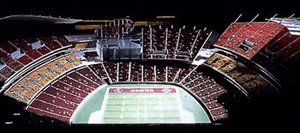
This 2006 proposal is the third attempt.
What's different with this one is simple in my view: the stadium model gives the look of a cheap facility -- the photo at the top of this post is the new proposal. Take a good look at it. Ok, the model itself is cheap, without the detailed seat representation I'm used to seeing, but there's more. For example, in all of the designs of seen for a stadium in the swirling winds of Candlestick Point, there's always been some kind of wind break or design that causes the wind not to swirl.
Take a look at the photo on the left -- it's the stadium part of the stadium mall proposed by Eddie DeBartolo and Carmen Policy. The extreme right side and near top of the photo shows the kind of hangover roof I'm referring to. And another view of this design is to the right. It looks like a complete stadium, without cutting corners.

Not this new design.
The new 49ers Stadium Proposal is open air at the top, with no shielding or protection of the crowd from the elements. In this, it looks like a high school stadium. The sideline seat structure does not hug the field, as do other designs. In fact, the last stadium proposal -- see the photos -- did have a seat structure that hugs the sidelines. The new proposal seems to have the stadium made in straight sections, rather than a smooth structure that hugs the field.
Yikes! .
Whatever's going on, it looks like project architects NHTB is cutting corners, or at least being told to do so. That's a mistake. As it looks now the stadium costs about $700 million and I predict that cost will increase to $1 billion.
That's terrible.
The 49ers staff and Mayor Gavin Newsome should check into this. As I told both the Mayor and a person working on the "San Francisco Olympic Bid" since the stadium's a part of the bid, any cost overuns may impact San Franciso's Olympic Bid.
Wednesday, October 25, 2006
NFL OWNERS APPROVE RESOLUTION TO STAGE INTERNATIONAL REGULAR-SEASON GAMES
NATIONAL FOOTBALL LEAGUE
280 Park Avenue, New York, NY 10017
(212) 450-2000 * FAX (212) 681-7573
WWW.NFLMedia.com
Joe Browne, Executive Vice President-Communications
Greg Aiello, Vice President-Public Relations
FOR IMMEDIATE RELEASE CONTACT:
NFL-104 10/24/06 MICHAEL SIGNORA, NFL, 212-450-2076
SIGNORAM@NFL.com
NFL OWNERS APPROVE RESOLUTION TO STAGE
INTERNATIONAL REGULAR-SEASON GAMES
The NFL will stage up to two international regular-season games per season beginning in 2007, further demonstrating the league’s commitment to competing in a global sports marketplace and to developing a greater presence beyond the
borders of the United States.
NFL club owners approved a resolution at a league meeting in New Orleans today that enables the league office to schedule up to two regular-season games per season outside the United States beginning in 2007 and continuing through
at least the 2011 campaign.
“This step comes in response to the tremendous and growing interest in the NFL around the world,” said NFL Commissioner ROGER GOODELL. “The owners believe that hosting a limited number of regular-season games outside the United
States on a regular basis is in the best interests of the league and will help to increase the fan base, build awareness of the NFL and grow the sport worldwide.”
Participating teams and venues will be decided at a later date with Canada, Germany, Mexico and the United Kingdom as potential host countries.
In 2005, the NFL staged its first-ever regular-season game outside the United States as the Arizona Cardinals hosted the San Francisco 49ers in Mexico City.
A crowd of 103,467 flocked to Azteca Stadium – the largest crowd for a regularseason game in NFL history.
The NFL has engaged in almost 20 years of international activity, including the preseason American Bowl series, the NFL Europe League, grass roots programs and customized television programming.
# # #
280 Park Avenue, New York, NY 10017
(212) 450-2000 * FAX (212) 681-7573
WWW.NFLMedia.com
Joe Browne, Executive Vice President-Communications
Greg Aiello, Vice President-Public Relations
FOR IMMEDIATE RELEASE CONTACT:
NFL-104 10/24/06 MICHAEL SIGNORA, NFL, 212-450-2076
SIGNORAM@NFL.com
NFL OWNERS APPROVE RESOLUTION TO STAGE
INTERNATIONAL REGULAR-SEASON GAMES
The NFL will stage up to two international regular-season games per season beginning in 2007, further demonstrating the league’s commitment to competing in a global sports marketplace and to developing a greater presence beyond the
borders of the United States.
NFL club owners approved a resolution at a league meeting in New Orleans today that enables the league office to schedule up to two regular-season games per season outside the United States beginning in 2007 and continuing through
at least the 2011 campaign.
“This step comes in response to the tremendous and growing interest in the NFL around the world,” said NFL Commissioner ROGER GOODELL. “The owners believe that hosting a limited number of regular-season games outside the United
States on a regular basis is in the best interests of the league and will help to increase the fan base, build awareness of the NFL and grow the sport worldwide.”
Participating teams and venues will be decided at a later date with Canada, Germany, Mexico and the United Kingdom as potential host countries.
In 2005, the NFL staged its first-ever regular-season game outside the United States as the Arizona Cardinals hosted the San Francisco 49ers in Mexico City.
A crowd of 103,467 flocked to Azteca Stadium – the largest crowd for a regularseason game in NFL history.
The NFL has engaged in almost 20 years of international activity, including the preseason American Bowl series, the NFL Europe League, grass roots programs and customized television programming.
# # #
Dallas Cowboys Coach Bill Parcells Picks Tony Romo As QB; Drew Bledsoe Says He's The Best
Dallas Cowboys Head Coach Bill Parcells picked Tony Romo as the starter after his three-interception, one touchdown performance against the New York Giants. I personally think it's a terrible idea, and will result in the Cowboys losing several games. Drew Bledsoe says he's the QB to win and I think he's correct. Here's what Drew said in the Dallas Morning News "blog."
In what was a break from club protocol, Drew Bledsoe held a news conference following the news of his demotion.
"Thanks for coming," he deadpanned at the start of the 10-minute session.
"In this league, it's day to day, week to week, and apparently half to half," Bledsoe said in reference to being yanked at halftime of Monday night's game.
He said Bill Parcells informed him of the decision during a 30-minute conversation this morning. He said he was "surprised" that Parcells would demote him, but that he still respected him.
"I really believe in my heart of hearts that I give us the best chance to win," Bledsoe said.
He called his experience during the second half of Monday's game "surreal." And when asked whether he thought he would've led the Cowboys to a victory, he said, "I have to believe we would've won. That's my makeup."
In what was a break from club protocol, Drew Bledsoe held a news conference following the news of his demotion.
"Thanks for coming," he deadpanned at the start of the 10-minute session.
"In this league, it's day to day, week to week, and apparently half to half," Bledsoe said in reference to being yanked at halftime of Monday night's game.
He said Bill Parcells informed him of the decision during a 30-minute conversation this morning. He said he was "surprised" that Parcells would demote him, but that he still respected him.
"I really believe in my heart of hearts that I give us the best chance to win," Bledsoe said.
He called his experience during the second half of Monday's game "surreal." And when asked whether he thought he would've led the Cowboys to a victory, he said, "I have to believe we would've won. That's my makeup."
The One Campaign Video Spot With Bono, Dave Matthews, P Diddy, Brad Pitt, and George Clooney
This is another video spot of The One Campaign:
Tuesday, October 24, 2006
The One Campaign Video Spot - Fight AIDS and Global Poverty
I found this video on YouTube, and just after I saw it on E! Network. Here's the paragraph introducing it"
ONE.org's new TV Spot asks millions of American voters to help fight global AIDS and extreme poverty. Add your support at http://www.ONE.org
The PSA brings together Matt Damon, Julia Roberts, George Clooney, Don Cheadle, New England Patriots Quarterback Tom Brady, singer songwriter Toby Keith, Alfre Woodard, journalist Nick Clooney, faith leaders Pastor Rick Warren and Bishop Charles E. Blake, Democratic and Republican Strategists Mike McCurry and Jack Oliver and Shayne Moore, a stay-at-home Mom and ONE supporter from Wheaton, Illinois.
Here's the video:
ONE.org's new TV Spot asks millions of American voters to help fight global AIDS and extreme poverty. Add your support at http://www.ONE.org
The PSA brings together Matt Damon, Julia Roberts, George Clooney, Don Cheadle, New England Patriots Quarterback Tom Brady, singer songwriter Toby Keith, Alfre Woodard, journalist Nick Clooney, faith leaders Pastor Rick Warren and Bishop Charles E. Blake, Democratic and Republican Strategists Mike McCurry and Jack Oliver and Shayne Moore, a stay-at-home Mom and ONE supporter from Wheaton, Illinois.
Here's the video:
Kevin Federline Parties in Vegas; Britney Spears Angry - Enquirer

K-Fed in action...
Unlike the O.J. Simpson story, I do believe this one. They're a very young couple, and too inexperienced to be good parents in my view. But we will see. No turning back, eh?
BRITNEY FUMES AS K-FED GETS SLEAZY IN VEGAS
By MICHAEL GLYNN - ENQUIRER
What happens in Vegas doesn't always stay in Vegas — just ask a furious Britney Spears. She's set to spear hubby Kevin Federline after he spent a wild weekend in Sin City — partying with his buddies and assorted beauties, insiders told The ENQUIRER.
"Britney feels outraged and betrayed," confided a close source. "Only three weeks after she gave birth to their new baby, Kevin vamoosed to Vegas with his buddies, who spent hours with young girls in his hotel suite.

"When Kevin returned to their Malibu home, Britney gave him the cold shoulder and then they had a terrible fight. It ended with Kevin staying over at a buddy's house."
Pick up this week's issue of The ENQUIRER to read all about it!
Published on: 10/13/2006
O. J. Simpson Denies Book Deal and Confession

I saw this in the National Enquirer:
OJ CONFESSES IN TELL-ALL BOOK
O.J. Simpson confesses to the bloody slaughter of his ex-wife Nicole Simpson and her pal Ron Goldman – and reveals he had an accomplice at the scene--in a bombshell new book!
Eleven years after Simpson was acquitted of the Murder of the Century, The ENQUIRER has learned exclusively that O.J. is being paid $3.5 million to describe the brutal knife attack blow-by-blow.
"Only that kind of money could have tempted O.J. to finally tell the truth," a West Coast source familiar with the top-secret book project told The ENQUIRER.
In the book, "he describes how he grabbed a knife from a man who accompanied him to Nicole’s home -- and moments later found himself covered in blood and looking down on the bodies of Nicole and Ron," said the source.
With its publication only weeks away, the tell-all blockbuster has remained the most explosive secret in publishing -- until now.
In its early chapters, O.J. paints a vivid picture of his life with Nicole and details their bitter divorce amid her affairs.
Finally, the disgraced Hall of Famer gets to June 12, 1994 – the night of the infamous double murder.
"O.J. prefaces these key pages by almost half-heartedly claiming this part of the book is hypothetical," said the source. "But I don’t think anyone is going to be convinced of that."
Because of "double jeopardy" laws, legal experts say O.J.'s confession will not likely lead to any legal trouble for him.
The book's working title is "If I Did It." But Simpson's account of the slayings is so chillingly realistic that it leaves no doubt it is a confession of what really happened.
...and I could not believe it. So I searched for his name and found this in the SF Chronicle..
O.J. Simpson Denies Book Confession
Former sports star and actor O.J. Simpson has slammed reports he is to be paid around $3.5 million for "admitting" to the killing of Nicole Brown and Ronald Goldman in a sensational new book.
A U.S. publication reported the star plans to publish his autobiography in which he will describe how he would have killed his ex-wife and Goldman, in an allegedly fictional manner. They were stabbed to death in 1994 and Simpson stood trial for the murders. He was found not guilty.
But Simpson's lawyer Yale Galanter denies the rumor. He tells the New York Daily News, "(Simpson) is not writing a book. We haven't been paid 35 cents, much less $3.5 million.
"If anyone comes out with such a book, I'll go on every talk show and call it crap."
Whatever is going on, it's clear that someone out there can't just leave O.J. alone. That's sad. He was acquitted in the criminal trial and the civil trial left out so much evidence it was a joke.
Asian Workers Shipped To Iraq To Build Embassy - Corpwatch
I thought we were supposed to be employing Iraqis, but according to this report, we're doing everything but that. On top of that, why does Iraq need the World's Largest US Embassy?
A U.S. Fortress Rises in Baghdad:
Asian Workers Trafficked to Build World's Largest Embassy
by David Phinney, Special to CorpWatch
October 17th, 2006
Things began looking more sketchier than ever to John Owen as he boarded a nondescript white jet on his way back to Iraq in March 2005 following some R&R in Kuwait city.
Employed by First Kuwaiti Trading & Contracting, the lead builder for the new $592-million US embassy in Baghdad, Owen remembers being surrounded at the airport by about 50 company laborers freshly hired from the Philippines and India. Everyone was holding boarding passes to Dubai -- not to Baghdad.
"I thought there was some sort of mix up and I was getting on the wrong plane," says the 48-year-old Floridian who was working as a general construction foreman on the embassy project.
He buttonholed a First Kuwaiti manager standing near by and asked what was going on. The manager waved his hand, looked around the terminal and whispered to keep quiet.
"'If anyone hears we are going to Baghdad, they won't let us on the plane,'" Owen recalls the manager saying.
'Not Valid for Iraq'
The secrecy struck Owen as a little odd, but he grabbed his luggage and moved on. Everyone filed out to the private jet and flew directly to Baghdad. "I figured that they had visas for Kuwait and not Iraq," Owen offers.
The deception had all the appearances of smuggling workers into Iraq, but Owen didn't know at the time that the Philippines, India, and other countries had banned or restricted their citizens from working in Iraq because of safety concerns and growing opposition to the war. After 2004, many passports were stamped "Not valid for Iraq."
Nor did Owen know that both the US State Department and the Pentagon were quietly investigating contractors such as First Kuwaiti for labor trafficking and worker abuse. In fact, the international news media had accused First Kuwaiti repeatedly of coercing workers to take jobs in battle-torn Iraq once they had been lured to Kuwait with safer offers.
The Kuwait-headquartered, Lebanese-run company has billed several billion dollars on US contracts since the war began in March 2003. Much of its work is performed by cheap labor largely hired from South Asia and the company has an estimated 7,500 foreign laborers in the theater of war.
Now, with a highly secretive contract awarded by the US State Department, First Kuwaiti is in the midst of building the most expensive and heavily fortified US embassy in the world. Scheduled to open in 2007, the sprawling complex near the Tigris River will equal Vatican City in size.
But Owen says that working on the project proved to be one of the worst jobs he has ever had in his 27 years of construction work.
Not one of the five different US embassy sites Owen had worked on around the world previously compared to the mess he describes. Armenia, Bulgaria, Angola, Cameroon and Cambodia all had their share of dictators, violence and economic disruption, but the companies building the embassies were always fair and professional, he says. First Kuwaiti is the exception. Brutal and inhumane, he says "I've never seen a project more fucked up. Every US labor law was broken."
Seven months after signing on with First Kuwaiti in November 2005, he quit.
In the resignation letter last June, Owen told First Kuwaiti and US State Department officials that his managers physically assaulted and beat the construction workers, demonstrated little regard for worker safety, and routinely breached security.
And it was all happening smack in the middle of the US-controlled Green Zone -- right under the nose of the State Department that had quietly awarded the controversial embassy contract in July 2005.
He also complained of poor sanitation, squalid living conditions and medical malpractice in the labor camps where several thousand low-paid migrant workers lived. Those workers, recruited on the global labor market from the Philippines, India, Pakistan and other poor south Asian countries, earned as little as $10 to $30 a day. As with many US-funded contractors, First Kuwaiti prefers importing labor because it views Iraqi workers as a security headache not worth the trouble.
Despite numerous emails and phone calls about such allegations, neither First Kuwaiti general manager Wadih Al Absi nor his lawyer Angela Styles, the former top White House contract policy advisor, have responded. After a year of requests, State Department officials involved with the project also have ignored or rejected opportunities for comment.
Your Passports Please
That same March Owen returned to work in Baghdad, Rory Mayberry would witness similar events after he flew to Kuwait from his home in Myrtle Creek, Oregon.
The gravely voiced, easy-going Army veteran had previously worked in Iraq for Halliburton and the private security company, Danubia. Missing the action and the big paychecks US contractors draw Iraq, he snagged a $10,000 a month job with MSDS consulting Company.
MSDS is a two-person minority-owned consulting company that assists US State Department managers in Washington with procurement programming. Never before had the firm offered medical services or worked in Iraq, but First Kuwaiti hired MSDS on the recommendation of Jim Golden, the State Department contract official overseeing the embassy project. Within days, an agreement worth hundreds of thousands of dollars for medical care was signed.
The 45-year-old Mayberry, a former emergency medical technician in the Army who worked as a funeral director in Oregon, responded to a help wanted ad placed by MSDS. The plan was that he would work as a medic attending to the construction crews on the work site in Baghdad.
Mayberry sensed things weren't right when he boarded a First Kuwaiti flight on March 15 to Baghdad -- a different flight from Owen's.
At the airport in Kuwait City, Mayberry said, he saw a person behind a counter hand First Kuwaiti managers a passenger manifest, an envelope of money and a stack of boarding passes to Dubai. The managers then handed out the boarding passes to Mayberry and 50 or so new First Kuwaiti laborers, mostly Filipinos.
"Everyone was told to tell customs and security that they were flying to Dubai," Mayberry explains. Once the group passed the guards, they went upstairs and waited by the McDonald's for First Kuwaiti staff to unlock a door -- Gate 26 -- that led to an unmarked, white 52-seat jet. It was "an antique piece of shit" Mayberry offers in a casual, blunt manner.
"All the workers had their passports taken away by First Kuwaiti," Mayberry claims, and while he knew the plane was bound for Baghdad, he's not so sure the others were aware of their destination. The Asian laborers began asking questions about why they were flying north and the jet wasn't flying east over the ocean, he says. "I think they thought they were going to work in Dubai."
One former First Kuwaiti supervisor acknowledges that the company holds passports of many workers in Iraq -- a violation of US contracting.
"All of the passports are kept in the offices," said one company insider who requested anonymity in fear of financial and personal retribution. As for distributing Dubai boarding passes for Baghdad flights, "It's because of the travel bans," he explained.
Mayberry believes that migrant workers from the Philippines, India and Nepal are especially vulnerable to employers like First Kuwaiti because their countries have little or no diplomatic presence in Iraq.
"If you don't have your passport or an embassy to go to, what you do to get out of a bad situation?" he asks. "How can they go to the US State Department for help if First Kuwaiti is building their embassy?"
Deadly 'Candy Store' Medicine
Owen had already been working at the embassy site since late November when Mayberry arrived. The two never crossed paths, but both share similar complaints about management of the project and brutal treatment of the laborers that, at times, numbered as many as 2,500. Most are from the Philippines, India, and Pakistan. Others are from Egypt and Turkey.
The number of workers with injuries and ailments stunned Mayberry. He went to work immediately after and stayed busy around the clock for days.
Labor Trafficking Under US Funded Iraq Contracts
CNN: Probe into Iraq Trafficking Claims – May 5, 2004
The New York Times: Indian Contract Workers in Iraq Complain of Exploitation – May 7, 2004
The Washington Post: Underclass of Workers Created in Iraq – July 1, 2004
Four days later, First Kuwaiti pulled him off the job after he requested an investigation of two patients who had died before he arrived from what he suspected was medical malpractice. Mayberry also recommended that the health clinics be shut down because of unsanitary conditions and mismanagement.
"There hadn't been any follow up on medical care. People were walking around intoxicated on pain relievers with unwrapped wounds and there were a lot of infections," he recalls. "The idea that there was any hygiene seemed ridiculous. I'm not sure they were even bathing."
In reports made available to the US State Department, the US Army and First Kuwaiti, Mayberry listed dozens of concerns about the clinics, which he found lacking in hot water, disinfectant, hand washing stations, properly supplied ambulances, and communication equipment. Mayberry also complained that workers' medical records were in total disarray or nonexistent, the beds were dirty, and the support staff hired by First Kuwaiti was poorly trained.
The handling of prescription drugs especially bothered him. Many of the drugs that originated from Iraq and Kuwait were unsecured, disorganized and unintelligibly labeled, he said in one memo. He found that the medical staff frequently misdiagnosed patients. Prescription pain killers were being handed out "like a candy store ... and then people were sent back to work."
Mayberry warned that the practice could cause addiction and safety hazards. "Some were on the construction site climbing scaffolding 30 feet off the ground. I told First Kuwaiti that you don't give painkillers to people who are running machinery and working on heavy construction and they said 'that's how we do it.'"
The sloppy handling of drugs may have led to the two deaths, Mayberry speculates. One worker, age 25, died in his room. The second, in his mid-30s, died at the clinic because of heart failure. Both deaths may be "medical homicide," Mayberry says -- because the patients may have been negligently prescribed improper drug treatment.
If the State Department investigated, Mayberry knows nothing of the outcome. Two State Department officials with project oversight responsibilities did not return phone calls or emails inquiring about Mayberry's allegations. The reports may have been ignored, not because of his complaints, but because Mayberry is a terrible speller, a problem compounded by an Arabic translation program loaded on his computer, he says.
Accidents Happen
Owen's account of his seven months on the job paints a similar picture to Mayberry's. Health and safety measures were essentially non-existent, he says. Not once did he witness a safety meeting. Once an Egyptian worker fell and broke his back and was sent home. No one ever heard from him again. "The accident might not have happened if there was a safety program and he had known how to use a safety harness."
Owen also says that managers regularly beat workers and that laborers were issued only one work uniform, making it difficult to go to the laundry. "You could never have it washed. Clothing got really bad -- full of sweat and dirt."
And while he often smuggled water to the work crews, medical care was a different issue. When he urged laborers to get medical treatment for rashes and sores, First Kuwaiti managers accused him of spoiling the laborers and allowing them simply to avoid work, he says.
State Department officials supervising the project are aware of many such events, but apparently do nothing, he said. Once when 17 workers climbed the wall of the construction site to escape, a State Department official helped round them up and put them in "virtual lockdown," Owen said.
Just before he resigned, hundreds of Pakistani workers went on strike in June and beat up a Lebanese manager who they accused of harassing them. Owen estimates that 375 laborers were then sent home.
'Treated Like Animals'
Recent First Kuwaiti employees agree that the accounts shared by Owen and Mayberry are accurate. One longtime supervisor claims that 50 to 60 percent of the laborers regularly protest that First Kuwaiti "treats them like animals," and routinely reduces their promised pay with confusing and unexplained deductions.
Another former First Kuwaiti manager, who declines to be named because of possible adverse consequences, says that Owen's and Mayberry's complaints only begin "to scratch the surface."
But scratching the surface is the only view yet available of what may be the most lasting monument to the US liberation and occupation of Iraq. As of now only a handful of authorized State Department managers and contractors, along with First Kuwaiti workers and contractors, are officially allowed inside the project's walls. No journalist has ever been allowed access to the sprawling 104-acre site with towering construction cranes raising their necks along the skyline.
Even this tight security is a charade, says on former high-level First Kuwaiti manager. First Kuwaiti managers living at the construction site regularly smuggle prostitutes in from the streets of Baghdad outside the Green Zone, he says.
Prostitutes, he explains are viewed as possible spies. "They are a big security risk."
But the exposure that the US occupation forces and First Kuwaiti may fear most could begin with the contractor itself and the conditions workers are forced to endure at this most obvious symbol of the American democracy project in Iraq.
David Phinney is a journalist and broadcaster based in Washington, DC, whose work has appeared in The Los Angeles Times, New York Times and on ABC and PBS. He can be contacted at: phinneydavid@yahoo.com.
A U.S. Fortress Rises in Baghdad:
Asian Workers Trafficked to Build World's Largest Embassy
by David Phinney, Special to CorpWatch
October 17th, 2006
Things began looking more sketchier than ever to John Owen as he boarded a nondescript white jet on his way back to Iraq in March 2005 following some R&R in Kuwait city.
Employed by First Kuwaiti Trading & Contracting, the lead builder for the new $592-million US embassy in Baghdad, Owen remembers being surrounded at the airport by about 50 company laborers freshly hired from the Philippines and India. Everyone was holding boarding passes to Dubai -- not to Baghdad.
"I thought there was some sort of mix up and I was getting on the wrong plane," says the 48-year-old Floridian who was working as a general construction foreman on the embassy project.
He buttonholed a First Kuwaiti manager standing near by and asked what was going on. The manager waved his hand, looked around the terminal and whispered to keep quiet.
"'If anyone hears we are going to Baghdad, they won't let us on the plane,'" Owen recalls the manager saying.
'Not Valid for Iraq'
The secrecy struck Owen as a little odd, but he grabbed his luggage and moved on. Everyone filed out to the private jet and flew directly to Baghdad. "I figured that they had visas for Kuwait and not Iraq," Owen offers.
The deception had all the appearances of smuggling workers into Iraq, but Owen didn't know at the time that the Philippines, India, and other countries had banned or restricted their citizens from working in Iraq because of safety concerns and growing opposition to the war. After 2004, many passports were stamped "Not valid for Iraq."
Nor did Owen know that both the US State Department and the Pentagon were quietly investigating contractors such as First Kuwaiti for labor trafficking and worker abuse. In fact, the international news media had accused First Kuwaiti repeatedly of coercing workers to take jobs in battle-torn Iraq once they had been lured to Kuwait with safer offers.
The Kuwait-headquartered, Lebanese-run company has billed several billion dollars on US contracts since the war began in March 2003. Much of its work is performed by cheap labor largely hired from South Asia and the company has an estimated 7,500 foreign laborers in the theater of war.
Now, with a highly secretive contract awarded by the US State Department, First Kuwaiti is in the midst of building the most expensive and heavily fortified US embassy in the world. Scheduled to open in 2007, the sprawling complex near the Tigris River will equal Vatican City in size.
But Owen says that working on the project proved to be one of the worst jobs he has ever had in his 27 years of construction work.
Not one of the five different US embassy sites Owen had worked on around the world previously compared to the mess he describes. Armenia, Bulgaria, Angola, Cameroon and Cambodia all had their share of dictators, violence and economic disruption, but the companies building the embassies were always fair and professional, he says. First Kuwaiti is the exception. Brutal and inhumane, he says "I've never seen a project more fucked up. Every US labor law was broken."
Seven months after signing on with First Kuwaiti in November 2005, he quit.
In the resignation letter last June, Owen told First Kuwaiti and US State Department officials that his managers physically assaulted and beat the construction workers, demonstrated little regard for worker safety, and routinely breached security.
And it was all happening smack in the middle of the US-controlled Green Zone -- right under the nose of the State Department that had quietly awarded the controversial embassy contract in July 2005.
He also complained of poor sanitation, squalid living conditions and medical malpractice in the labor camps where several thousand low-paid migrant workers lived. Those workers, recruited on the global labor market from the Philippines, India, Pakistan and other poor south Asian countries, earned as little as $10 to $30 a day. As with many US-funded contractors, First Kuwaiti prefers importing labor because it views Iraqi workers as a security headache not worth the trouble.
Despite numerous emails and phone calls about such allegations, neither First Kuwaiti general manager Wadih Al Absi nor his lawyer Angela Styles, the former top White House contract policy advisor, have responded. After a year of requests, State Department officials involved with the project also have ignored or rejected opportunities for comment.
Your Passports Please
That same March Owen returned to work in Baghdad, Rory Mayberry would witness similar events after he flew to Kuwait from his home in Myrtle Creek, Oregon.
The gravely voiced, easy-going Army veteran had previously worked in Iraq for Halliburton and the private security company, Danubia. Missing the action and the big paychecks US contractors draw Iraq, he snagged a $10,000 a month job with MSDS consulting Company.
MSDS is a two-person minority-owned consulting company that assists US State Department managers in Washington with procurement programming. Never before had the firm offered medical services or worked in Iraq, but First Kuwaiti hired MSDS on the recommendation of Jim Golden, the State Department contract official overseeing the embassy project. Within days, an agreement worth hundreds of thousands of dollars for medical care was signed.
The 45-year-old Mayberry, a former emergency medical technician in the Army who worked as a funeral director in Oregon, responded to a help wanted ad placed by MSDS. The plan was that he would work as a medic attending to the construction crews on the work site in Baghdad.
Mayberry sensed things weren't right when he boarded a First Kuwaiti flight on March 15 to Baghdad -- a different flight from Owen's.
At the airport in Kuwait City, Mayberry said, he saw a person behind a counter hand First Kuwaiti managers a passenger manifest, an envelope of money and a stack of boarding passes to Dubai. The managers then handed out the boarding passes to Mayberry and 50 or so new First Kuwaiti laborers, mostly Filipinos.
"Everyone was told to tell customs and security that they were flying to Dubai," Mayberry explains. Once the group passed the guards, they went upstairs and waited by the McDonald's for First Kuwaiti staff to unlock a door -- Gate 26 -- that led to an unmarked, white 52-seat jet. It was "an antique piece of shit" Mayberry offers in a casual, blunt manner.
"All the workers had their passports taken away by First Kuwaiti," Mayberry claims, and while he knew the plane was bound for Baghdad, he's not so sure the others were aware of their destination. The Asian laborers began asking questions about why they were flying north and the jet wasn't flying east over the ocean, he says. "I think they thought they were going to work in Dubai."
One former First Kuwaiti supervisor acknowledges that the company holds passports of many workers in Iraq -- a violation of US contracting.
"All of the passports are kept in the offices," said one company insider who requested anonymity in fear of financial and personal retribution. As for distributing Dubai boarding passes for Baghdad flights, "It's because of the travel bans," he explained.
Mayberry believes that migrant workers from the Philippines, India and Nepal are especially vulnerable to employers like First Kuwaiti because their countries have little or no diplomatic presence in Iraq.
"If you don't have your passport or an embassy to go to, what you do to get out of a bad situation?" he asks. "How can they go to the US State Department for help if First Kuwaiti is building their embassy?"
Deadly 'Candy Store' Medicine
Owen had already been working at the embassy site since late November when Mayberry arrived. The two never crossed paths, but both share similar complaints about management of the project and brutal treatment of the laborers that, at times, numbered as many as 2,500. Most are from the Philippines, India, and Pakistan. Others are from Egypt and Turkey.
The number of workers with injuries and ailments stunned Mayberry. He went to work immediately after and stayed busy around the clock for days.
Labor Trafficking Under US Funded Iraq Contracts
CNN: Probe into Iraq Trafficking Claims – May 5, 2004
The New York Times: Indian Contract Workers in Iraq Complain of Exploitation – May 7, 2004
The Washington Post: Underclass of Workers Created in Iraq – July 1, 2004
Four days later, First Kuwaiti pulled him off the job after he requested an investigation of two patients who had died before he arrived from what he suspected was medical malpractice. Mayberry also recommended that the health clinics be shut down because of unsanitary conditions and mismanagement.
"There hadn't been any follow up on medical care. People were walking around intoxicated on pain relievers with unwrapped wounds and there were a lot of infections," he recalls. "The idea that there was any hygiene seemed ridiculous. I'm not sure they were even bathing."
In reports made available to the US State Department, the US Army and First Kuwaiti, Mayberry listed dozens of concerns about the clinics, which he found lacking in hot water, disinfectant, hand washing stations, properly supplied ambulances, and communication equipment. Mayberry also complained that workers' medical records were in total disarray or nonexistent, the beds were dirty, and the support staff hired by First Kuwaiti was poorly trained.
The handling of prescription drugs especially bothered him. Many of the drugs that originated from Iraq and Kuwait were unsecured, disorganized and unintelligibly labeled, he said in one memo. He found that the medical staff frequently misdiagnosed patients. Prescription pain killers were being handed out "like a candy store ... and then people were sent back to work."
Mayberry warned that the practice could cause addiction and safety hazards. "Some were on the construction site climbing scaffolding 30 feet off the ground. I told First Kuwaiti that you don't give painkillers to people who are running machinery and working on heavy construction and they said 'that's how we do it.'"
The sloppy handling of drugs may have led to the two deaths, Mayberry speculates. One worker, age 25, died in his room. The second, in his mid-30s, died at the clinic because of heart failure. Both deaths may be "medical homicide," Mayberry says -- because the patients may have been negligently prescribed improper drug treatment.
If the State Department investigated, Mayberry knows nothing of the outcome. Two State Department officials with project oversight responsibilities did not return phone calls or emails inquiring about Mayberry's allegations. The reports may have been ignored, not because of his complaints, but because Mayberry is a terrible speller, a problem compounded by an Arabic translation program loaded on his computer, he says.
Accidents Happen
Owen's account of his seven months on the job paints a similar picture to Mayberry's. Health and safety measures were essentially non-existent, he says. Not once did he witness a safety meeting. Once an Egyptian worker fell and broke his back and was sent home. No one ever heard from him again. "The accident might not have happened if there was a safety program and he had known how to use a safety harness."
Owen also says that managers regularly beat workers and that laborers were issued only one work uniform, making it difficult to go to the laundry. "You could never have it washed. Clothing got really bad -- full of sweat and dirt."
And while he often smuggled water to the work crews, medical care was a different issue. When he urged laborers to get medical treatment for rashes and sores, First Kuwaiti managers accused him of spoiling the laborers and allowing them simply to avoid work, he says.
State Department officials supervising the project are aware of many such events, but apparently do nothing, he said. Once when 17 workers climbed the wall of the construction site to escape, a State Department official helped round them up and put them in "virtual lockdown," Owen said.
Just before he resigned, hundreds of Pakistani workers went on strike in June and beat up a Lebanese manager who they accused of harassing them. Owen estimates that 375 laborers were then sent home.
'Treated Like Animals'
Recent First Kuwaiti employees agree that the accounts shared by Owen and Mayberry are accurate. One longtime supervisor claims that 50 to 60 percent of the laborers regularly protest that First Kuwaiti "treats them like animals," and routinely reduces their promised pay with confusing and unexplained deductions.
Another former First Kuwaiti manager, who declines to be named because of possible adverse consequences, says that Owen's and Mayberry's complaints only begin "to scratch the surface."
But scratching the surface is the only view yet available of what may be the most lasting monument to the US liberation and occupation of Iraq. As of now only a handful of authorized State Department managers and contractors, along with First Kuwaiti workers and contractors, are officially allowed inside the project's walls. No journalist has ever been allowed access to the sprawling 104-acre site with towering construction cranes raising their necks along the skyline.
Even this tight security is a charade, says on former high-level First Kuwaiti manager. First Kuwaiti managers living at the construction site regularly smuggle prostitutes in from the streets of Baghdad outside the Green Zone, he says.
Prostitutes, he explains are viewed as possible spies. "They are a big security risk."
But the exposure that the US occupation forces and First Kuwaiti may fear most could begin with the contractor itself and the conditions workers are forced to endure at this most obvious symbol of the American democracy project in Iraq.
David Phinney is a journalist and broadcaster based in Washington, DC, whose work has appeared in The Los Angeles Times, New York Times and on ABC and PBS. He can be contacted at: phinneydavid@yahoo.com.
Atlanta Falcons Tickets Exchange - Buy or Sell Falcons Tickets
Atlanta Falcons Tickets for sale for all games. Just click here: "Atlanta Falcons"
Atlanta Falcons Tickets Exchange - Buy or Sell Falcons Tickets
Get Atlanta Falcons tickets for all games with a click here "Atlanta Falcons" Se the exciting Falcons with Michael Vick.
Subscribe to:
Comments (Atom)