Monday, April 03, 2006

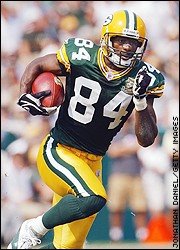
Green Bay Packers WR Javon Walker Does Not Want to Return To Lambeau Field - AP


Walker's threats ignored
Packers won't give in to wide receiver

MILWAUKEE (AP) - Wide receiver Javon Walker says he'd rather retire than return to Green Bay and play for the Packers. General manager Ted Thompson says he has no plans to placate the former Pro Bowler.

Walker, rehabilitating his right knee at his former college Florida State, told ESPN.com on Thursday that he wants to be traded or released.

"If I had to go back there, I'd retire," he said. "I don't have to play."


Thompson, who has reorganized the Packers in his 14-month tenure by firing former head coach Mike Sherman and bringing in Mike McCarthy, said Friday the organization will not concede to Walker's demands.

"During his time as a Green Bay Packer, Javon Walker has been well thought of by everyone here. I like Javon, certainly as a person and a player," he said in a statement. "There have been several highly publicized cases of player discontent in the National Football League. I don't anticipate us making any concessions in this matter."

Walker's new agent, Kennard McGuire of CSMG Sports, asked Thompson to move the veteran entering his sixth year or pursue a trade. His former agent, Drew Rosenhaus, made similar requests to management.

McGuire did not return messages left Friday by The Associated Press.

"I just don't feel like this is the best place for me to be right now," Walker told ESPN.com. "I really have no interest in being in a Green Bay Packers uniform or playing for Green Bay again."

Walker has been at odds with the organization since management refused to renegotiate his contract that had two years remaining on it after his Pro Bowl season in 2004, when he caught 89 passes for 1,382 yards and 12 touchdowns.

Brett Favre criticized Walker's threat of holding out in 2005, and Walker returned only to tear a knee ligament in the season opening loss to Detroit.

"I just don't like the way the organization runs itself," Walker said. "They want players to come up there and play hard and work hard, but when it comes time to be compensated, it's like, 'We forgot what you've done."'

Walker also said Favre's comments last year made living in Wisconsin difficult, and he felt it was unfair the team let Favre interfere with Walker's squabble with management.

"There's an unwritten rule that players stick together," Walker said.

Walker says he will not show up for training camp or come back at all for the final season of his contract regardless of whether Favre decides to retire or return. He said he'll repay the Packers the prorated portion of his signing bonus to leave Green Bay.

"Why should I risk another year of getting beat up playing for a team that I don't want to play for? That's stupid," he said.

Walker said he'll be ready for the 2006 season wherever he lands.

"If I'm going to go out and take hits, it's going to be for a team that I love playing for," he said. "I'm not going to grandstand. I just want the Packers to give me peace of mind."

For now, the Packers say the only way Walker will be free to play elsewhere is if he finishes what he started in Green Bay.

"Javon is under contract," Thompson said. "We expect him to honor it."

Sunday, April 02, 2006

Reggie Bush USC Pro Day Gets Rave Reviews - 4.33 40-Yard Dash and 225 Pounds at 25 Reps - Houston Chronicle


He's ready to be drafted by the Texans. The question is, if you're the Indy Colts, who do you draft to stop him? I'll give that answer soon.


April 3, 2006, 1:14AM
Bush has powerful showing
RB demonstrates strength to go with 4.33 speed in 40

By MEGAN MANFULL
Copyright 2006 Houston Chronicle

LOS ANGELES - Southern California running back Reggie Bush entered his workout for the NFL scouts Sunday as if it were a game. It wasn't simply about targeting specific numbers.

Bush had just one specific objective: to secure his place as the No. 1 overall pick in the draft. By late Sunday afternoon, he stood outside the USC practice facility confident he had done just that.


"There's always that .1 percent chance, but pretty much I figure 99.9 percent I am (the top pick)," said Bush, who checked in at 5-11, 202 pounds. "I did a pretty good job today. I think I proved to them that I should be the No. 1 pick."

With a ticket to Houston on his mind, Bush was nearly flawless in the different stations. He ran the fastest time of the day in the 40-yard dash — 4.33 seconds. He recorded the highest vertical jump — 40.5 inches. And he recorded the longest broad jump — 10 feet, 8.5 inches.

The biggest surprise to the more than 150 scouts and NFL personnel watching, however, was Bush's ability to complete 24 repetitions on the 225-pound bench press. That beat the majority of his teammates, many of whom are bigger than him.

"He took his shirt off, and I mean, he was huge," USC quarterback Matt Leinart said. "You should have seen the looks on (the scouts') faces. They already know how fast he is. They didn't know he looked like that."

Bush hopes that image stays with NFL scouts, who have criticized him at times because of his size.

It was an image that definitely left an impression on Texans coach Gary Kubiak and general manager Charley Casserly, who watched every move Bush made.

"That was my biggest surprise," Kubiak said. "I knew he was what he was. But to bench-press what he did at his size was pretty impressive."


Young vs. Bush

The Texans are weighing their options between drafting Bush or Texas quarterback Vince Young. They will meet with both players at their Houston offices this week, and because they hold the top pick in the draft, they can begin contract negotiations with one or more players at any time.
Bush will visit Reliant Stadium on Thursday. Young will visit and go through an on-field workout with the Texans on Friday.

Bush doesn't figure his association with Young will end even after the draft. The rivalry that grew between them in college is one Bush expects to continue in the NFL, especially if they are drafted by teams in the AFC.

"They will try to make that Reggie Bush vs. Vince Young," Bush said. "I think it'd be good. It'd just be an ongoing rivalry."


'Class individual'

Bush, who has never visited Houston, will be joined Thursday by his agent, Joel Segal, and his marketing consultant, Mike Ornstein. Because Bush had dinner Saturday night with Casserly and Kubiak, much of Thursday will be spent meeting with Texans owner Bob McNair and some of the assistant coaches.
"We spent a couple of hours with him, and you get a little more read on his personality, more than a 15-minute interview in Indianapolis," Casserly said. "I think he's a class individual, well-spoken, genuine."

Many in the league agree with Bush, taking it as a foregone conclusion he will land in Houston on April 29. That doesn't mean other teams weren't setting up meetings, though.

After Bush's four-hour workout, Tennessee Titans general manager Floyd Reese, coach Jeff Fisher and offensive coordinator Norm Chow met with Bush. After working with him for two years as the offensive coordinator at Southern Cal, Chow praised his former standout.

"I think he's a tremendous player," Chow said. "He's so explosive."

As for the potential of playing against him two times each season, Chow was less thrilled.

"We don't want to even think about it," he said.

megan.manfull@chron.com

Penn State QB Michael Robinson and Boston College WR Will Blackmon: Tweeners for the 2006 NFL Draft - Pro Sports Group's Jeff West

Tweeners for the 2006 NFL Draft

A couple months ago, Consensus Draft Services explained the definition of a "tweener" prospect for the NFL Draft. A tweener is a player who may play one position in college, but be ill-suited for that same position as a professional. Generally this occurs when a player has the athleticism to excel at the position in college, but does not have the requisite size needed to play the same position at the professional level.

In April of 2005, DeMarcus Ware (Troy State) was selected in the first half of the first round based on his athleticism. As a collegiate defensive end he played at 225 pounds and used his athleticism to dominate his opponents. A 225-pound defensive end would likely be tossed around easily by most NFL offensive tackles. So Ware made the transition from a 4-3 defensive end to a 3-4 outside linebacker and was coveted by NFL teams once they saw he had the athleticism to make the switch. A few picks after Ware was selected, the outstanding Georgia defensive end, David Pollack, was selected by the Bengals with the intent to move him to a 4-3 outside linebacker position.

Now the 2006 NFL Draft is approaching and a new group of "tweeners" has emerged. CDS will take a look at some of them in this issue.

The play of Michael Robinson at quarterback has been largely responsible for the success Penn State has enjoyed this season. Robinson is a big play QB who can succeed in the right system in college, but scouts believe he will likely have to consider a move to wideout or running back to continue playing as a professional. He certainly has the athleticism to make the change, following in the footsteps of a player like Antwaan Randle-El.

Another player who is considered a tweener, not based on size or athleticism, but experience, is Boston College's Will Blackmon. Some players are firmly entrenched in a position in college, only to have to learn a new one in the NFL. Others have the advantage of a head start. After establishing himself as one of the top corners in the NCAA as a junior, Blackmon decided to give wideout a try as a senior. However, despite some moderate success at WR, CDS believes that he will be drafted as a corner since truly good ones are so hard to find. He would be a nice double threat in the NFL, much like Champ Bailey and Deion Sanders were early in their careers, however he has probably hurt his draft status some since he has not played much corner as a senior.

One position that is sometimes hard to define is the H-back position. Is the player a tight end or is he a fullback (or both)? Tulsa's Garrett Mills is one of the most productive tight ends in the country, yet he wasn't even considered for the Mackey Award because of his ability to line up in the backfield as a blocker. Vernon Davis (Maryland), a junior who might consider declaring for the draft, is another player who would be ideal in the H-back position. He is a bit undersized to be used as a blocker on the line of scrimmage consistently in the NFL, but would be a dangerous threat as a receiver out of the backfield and would be very effective picking up the blitz with his blocking ability.

There are a number of other players following in the footsteps of DeMarcus Ware and David Pollack for the upcoming draft. North Carolina State's Manny Lawson has had a solid year as an undersized pass-rushing end, however at 240 pounds with outstanding athletic ability and blazing speed, he will likely be looked at as an OLB in the NFL. Brandon Guillory of Louisiana-Monroe could be this year's Ware, coming from a small program to make draft headlines. Guillory, with a strong showing during post-season workouts, should garner some interest as a 3-4 OLB who has pass-rushing ability along with the athleticism and speed to drop back into coverage when needed. Florida State's Kamerion Wimbley is quickly climbing draft boards with his production as a sack artist in 2005, however he too is undersized by NFL DE standards at only 240 pounds. If he puts up good 40-yard dash times after the season, he could be a candidate to switch to a 3-4 outside backer. A little-known prospect from tiny Anderson University in Indiana, Wyatt Gayer should make some noise this off-season with his workouts. Gayer is a smallish DE (6' 2" and 250 pounds) who projects well to a 3-4 OLB position. He is productive on the field and is an amazing athlete with surprising speed, quickness, and strength.

There are a number of collegiate defensive tackles who might not have the size or strength to play the position in the pros. LSU's Claude Wroten is a 4-3 DT who is having an outstanding season. He has the size and speed and strength to continue playing the position at the next level, but he's really ideally suited to be a 3-4 defensive end. At nearly 300 pounds with uncommon quickness, he could be dominant at that position. There are some DTs in college who are productive without Wroten's size. Cal-Poly's Chris Gocong leads the nation in sacks playing a lot of 3-4 DT at about 265 pounds. He would have trouble holding up at the point of attack inside in the pros (unless he was able to add another 25+ pounds while maintaining his strength), so he will likely be looked at as a DE because of his athleticism and speed (4.7 forty).

Another common move for prospects is from linebacker to strong safety. A strong safety has to be tough enough to be an effective run stopper, but still quick enough to provide solid pass coverage. Michael Boulware of Seattle made the switch after it was determined that he was too small to play outside linebacker in the NFL. Auburn's Antarrious Williams has played weakside linebacker quite effectively in college, but is too small to consistently take on the bigger blockers in the NFL. He does have the speed and coverage skills to effectively make the change to strong safety in the NFL. Stanford's Jon Alston is another player who has outstanding speed and athleticism at the OLB position, but at 6' 1" and 220 pounds with very good speed, he's a prime candidate to be tried at the SS position where his size would be a better fit. Devin Conwell of Ashland (Ohio) University is a tad small for the LB position at 6' 2" and 216 pounds, and has seen some work at SS this year. With his athleticism and football intelligence, the big-hitting Conwell could be a nice sleeper tweener in the NFL Draft.

Finally, the last move to be discussed is the cornerback to safety (or vice-versa) switch. One of the top prospects coming into the season was Tennessee's Jason Allen. He was a stand-out free safety who might have been a first-round selection in 2005, however he agreed to go back to Knoxville for his senior campaign if he was allowed to switch to corner, a more coveted position. By all accounts, he was playing well at corner before suffering a season-ending injury. It will be interesting to see how quickly he can get back to good health and what position he will be drafted for. Jimmy Williams is another player who can play either the corner or safety position. His versatility and skill at both positions will likely make him a top ten selection in April.

There is a marked difference between the collegiate game and the NFL, and success and production at a position at the collegiate level does not guarantee the same success in the NFL. However, a player may translate success at one position into opportunity at another position.


--------------------

Jeff West - Site Editor, Scout, Writer, Administrator

Saturday, April 01, 2006

Next Buys Disney! Steve Jobs Plans To Transform Disney World


Steve Jobs, Chairman and CEO of Next, Inc., as well as Apple Computer, annouced that Next purchased Disney for just north of $234 billion today, in a hostile takeover. Jobs and his investment bankers used Next, believed dead, as the holding company for their takeover bid.

"I'm ready to bring Disney into the 21st Century," Jobs said as Snow White and the Seven Dwarfs stood behind him with perfect Disney smiles.

Jobs also revealed plans to transform Walt Disney World in to the real EPCOT, or Experimental Prototype Community of Tommorrow. "Walt never got to see his dream come to life. We're going to make it happen. There are too many problems in our cities not to have an urban lab of some kind. EPCOT will be just that."

He also said that Disney would convince the NFL to allow it to establish a franchise in Los Angeles. "We can clear up the mess that the other deals the NFL's looking at are, and build a new kind of sports company around the new LA franchise."

Jobs also took time to appologize for how Disney treated A.A Miline, the creator of the "Winnie The Poo" cartoons, who claimed Disney owned it $200 milllion in back revenues from the "Poo" property. "Disney will do everything to clean up this mess," Jobs said, "and restore Winnie The Poo and Tigger, too, to the Disney family."

April fool!

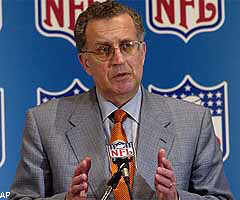
Commissioner Tagliabue Press Conference, Annual League Meeting Orlando, FL -- March 29, 2006


From NFL Media.com

Commissioner Tagliabue

Good afternoon. We've covered a lot of ground since I saw you on Monday. I think in a nutshell
we had a really good report from the Competition Committee. You've just heard about all of
that. Once again they've done a terrific job, and I think the membership recognized that with the
endorsement they had of most of their recommendations. Other than that, we had many reports
and a lot of discussion about short-term things -- 2006 season -- and some long-term things --
business in the United States -- and some discussions about where we are headed internationally
in Europe, Asia, and elsewhere.

I know that you have many different subjects on your minds, so I'll go ahead and take your
questions.

Q: Are you still confident that you can retire in July (with a successor in place)?

PT: Am I still confident I can be out of here by July? I think so. Yes. It doesn't really matter
whether it's the 28th of July or the 10th of August. The only reason we've talked about July is
because that's I discussed with Dan Rooney, and we estimated that this could take four months.
If it takes two and a half, fine. If it takes five and a half, that's fine, too.

The one thing that might be extended, just in terms of being practical, is that there's a dead
period in the league from June 15 to July 15 where not a lot happens on any front because most
clubs take vacations. I'll be taking some vacation then, too, which we did discuss with the
owners. The practicalities of the NFL calendar are that when minicamps end in mid-June, a lot of
teams go to part-time schedules. Coaches take vacations, players leave, front office staff leave,
and they don't resume until sometime after the Fourth of July. That's got to be factored into the
timeline.

Q: So you are confident you will not have to go through the next season as Commissioner?
PT: Yes. Other than as a fan.

Q: What are the odds that the NFL will play a game in China (in 2007)?

PT: I think they are increasing. We've had some discussions on that. Our own international
people have been to China a number of times. I was there last May and met with representatives
of the city of Beijing, their Olympic Committee and the Mayor of Beijing. We and NBC have
been having those discussions. I think there's an increasing prospect that we could have a game
there in August 2007, which would be the beginning of the one-year countdown to the following
year's Olympics, which will begin on 8/8/08.

Q: Can you comment on the size and makeup of the search committee for the next
commissioner?

PT: We've talked to the owners about a committee of no fewer than six and no more than eight,
but that's not cast in concrete.

Q: When will the committee be announced?

PT: Probably sometime next week.

Q: If you could reflect back on the Cleveland situation 10 years ago, how do you view that
problem as it arose and how it was resolved?

PT: I guess I view it today pretty much as I viewed it then. It was a very traumatic thing for the
Browns' fans, the franchise and the league. The traumatic aspects of it were compounded by the
fact that Baltimore had had a similar trauma in '84 -- losing its team. So we had two cities, two
states, and two groups of fans -- great fans for many, many decades -- to deal with. Great
traditions. Some of the greatest players ever in the league played with the Colts and the Browns.
So that was very traumatic. I think the solution that was reached involved some considerable
give on all sides. Mayor White was terrific. Al Lerner was terrific throughout. Hopefully the
solution that was reached, which was novel, was one for the long term.
One of the personal regrets is that Al's health caught up with him, and he couldn't be there to see
a Super Bowl. I know that is the team's goal, that's Randy's goal, but it would have been nice if
Al had been there to pursue it.

Q: Do you continue to keep playing regular season games overseas?

PT: I think that we had an excellent report by our new head of international -- Mark Waller. We
presented the idea that going forward after 20 years of preseason games in non-U.S. venues,
starting with the Cowboys and the Bears in '86 in Wembley Stadium up through Tokyo last
summer, that the priority now has to be to institutionalize arrangements to have live, regularseason
games plus other important NFL events such as the Pro Bowl, for example outside of the
U.S. because the fans now are interested and they want to be part of the regular season or want to
be part of other events like the Pro Bowl. So that's going to be our focus, and we started some
conversation yesterday with the owners about what kind of a structure, what kind of
commitments it would take from all the teams to institutionalize that so the obligation of playing
a game every now and then, a regular season game, outside of the United States would become a
part of the normal team participation in the National Football League.

Q: Do you view the Mexico City game last year as an experiment or a success?

PT: I think it was a resounding success. I think it was built upon the preseason games we had
down there. It built upon the fan interest that's there. It was a resounding success both in Mexico
and the United States, and the two teams (49ers and Cardinals) view it that way, as does the
whole league.

Q: Regarding Los Angeles, you already have a 32-team template that works perfectly. Does
that mean the league would have to move a team into Los Angeles once that situation is
settled out there?

PT: Not necessarily. We've operated with odd numbers of teams. We've operated with divisions
with different numbers of teams. We'll be looking at all kinds of alternatives. I think that the key
thing here at this meeting was that we had a positive reaction to the proposals that have been
developed by our staff with the Coliseum and Anaheim. I'm expanding our working group of
owners by adding six owners to the five we've had. We'll now have an 11-owner group and
we'll be expecting to have meetings either in April or early May with representatives of the
Coliseum and Anaheim to put this to hopefully some decision at our May meeting.

Q: Is the escalating cost of building stadiums a deterrent to this project or to expansion
because then you'd have a huge fee to build a stadium and then another huge fee to
purchase a franchise?

PT: Yes. I think the escalating cost of anything in life, the escalating cost of a pair of shoes are a
deterrent to having two or three pairs. It's sort of obvious. So yes, it's an issue.
I remember when I was a kid I had baseball spikes and I wanted to run track, and my father told
me to run the mile with baseball spikes, which was not good for your feet, because two sets of
spikes were unnecessary. They were expensive. So I've always had that philosophy. In fact, I
won the state high school high jump championship with baseball spikes.

Q: It must have been a weak field?

PT: It was a weak field. Very weak. That's a different issue. Costly shoes and a weak field -- you
can still succeed.

Q: Will the search committee hire the consulting firm or will you?

PT: It would be a decision the committee would make after we interview multiple firms.

Q: Are you concerned about the perception of officiating in the playoffs with so many fans
convinced that there were bad calls?

PT: No.

Q: Why didn't you fine Mike Holmgren for his comments?

PT: We discussed that with Mike this morning. He said earlier in the meeting that he wanted to
make it totally clear that the Steelers won the game fair and square and he emphasized that at
several different points during the meeting. Then I spoke with him this morning, and he spoke
with me. He said that he just wanted to express strong appreciation for the relationship we've
had and what he's learned from me. I felt the same way.

We talked about the fact that Mike Holmgren was one of the first coaches, if not the first, to
emphasize to me how important it was for me as the commissioner to make myself accessible to
the assistant coaches, to the coordinators. We talked about a meeting we had in Green Bay when
he was the head coach and I was visiting training camp and expected to spend most of my time
with the players, or with the head coach, or with the Packers executive committee. But Mike
urged me to have lunch with all the assistant coaches and coordinators. Then Fritz Shurmur
wrote me a note later saying he'd been in the league for 34 years and never had had a prior
conversation with a commissioner, but it was one of the most important things that ever
happened in Fritz Shurmur's life. From that point forward, whenever I went to training camps, I
would meet with assistant coaches and coordinators whenever I could.

We talked this morning about learning from each other, and then he said that he knows he
popped off a little bit about the officiating after the Super Bowl. I told him I had a letter on my
desk written by my staff to fine him, but that that particular letter falls under the category of
something I learned a long time ago -- the first draft of a letter is better put in the trash can than
sent to the addressee, which means you should think twice before you start firing letters off. I
think the issue is resolved.

Q: How important is it that this search committee be diverse economically and
geographically? Is that important?

PT: Yes. We had some discussions yesterday with the owners about whether the committee
should be one owner from each division or whether there was any one factor that should
determine how the committee would be composed. I expressed the view that there was no single
litmus test, that if you wanted to have a representative committee, you'd have to look at multiple
factors. That's the way we'll approach it.

Q: There's a lot of complaints from fans about too much drinking in the stands. What's
your stance on that?

PT: I think we've had fewer complaints on that than we've had on the doubleheader games
starting at 1:00 P.M. in Jacksonville.

Q: Who's complaining about that?

PT: I thought that's what you asked me the other day. Were we going to start that Dallas-
Jacksonville game at 1:00 P.M. or 4:00 P.M.?

Q: But seriously, don't you get complaints like that?

PT: I'm sure the teams do and sometimes they get to my attention. We've had programs over the
years with the teams run through the league about fan behavior, and the teams make it a big
priority including having their security people be very attentive, policies about when beer is
served, when beer is not served. We have technology in the stadiums, cameras and other
technology, to identify unruly fans and revoke their season tickets. So, yes, that's part of sports.
It's part of American life, I guess. That happens at the beach, too, not just at NFL stadiums.

Q: On the issue of minority hiring, there seems to be fewer minorities on the offensive side
of the ball in coordinator positions. Have you looked at that at all?

PT: We have looked at that. I think over the years the numbers have kind of flipped back and
forth. At particular points in time it seems like there would be more on the defensive side, other
points of time, more on the offensive side. Why that is, no one seems to know.
We've tried to encourage the teams, if it's an issue of responsibility, to broaden responsibility. If
it's an issue of participation by position coaches in meetings with the coordinators and head
coaches to try to address it. It's something that's been discussed, and we try to address it
internally with our diversity committee and with some of the ways that we structure programs at
the coaching seminars that we run in May. The answer is yes.

Q: With the NFL Network preparing to broadcast its first regular-season game this
Thanksgiving, considering the billions of dollars that are involved with other networks,
what do you see as the potential for the Network to broadcast more games in the future?
Has the idea of pay-per-view ever been entertained?

PT: No. Our focus for the next six years is the eight games. We're going to be very careful to
make those incremental in terms of when they are played. When you boil it all down, it's about
three or four incremental national games. We had some Saturday games on CBS and FOX which
are now kind of folded into primetime and will be run on the NFL Network. I think we've gone
from 92 national games to 96 or something like that. It's a very small increment. There's been no
discussion of pay-per-view. It really is an effort to get games that otherwise might be regional
telecasts or national games on other networks in a couple of instances onto a nationally distributed network.

Q: If the Kansas City proposal were ever to get approved, would putting those extra games
on the NFL Network be a consideration?

PT: It's not something we've ever discussed, because I have never thought the idea of expanding
the playoffs was compelling. It's not anything we've ever discussed and I wouldn't anticipate
that. I think the playoff games will remain on our outside networks, if we ever have any more
games. Like I said, I don't think it's a good idea. We're going to discuss it at the May meeting, in
terms of expanding the playoffs.

Q: Why do you like the current format as is?

PT: Because it works. I think that when you go beyond that, you get into dilution and other
issues you shouldn't be getting into.

Thank you very much.
###

Friday, March 31, 2006

Michael Eisner as NFL Commissioner? Just Say No


Some silly goose with a sports mag I will not name floated former Disney head Michael Eisner as a candidate for the NFL Commissioner's job.

Please don't hire him.

Eisner's not in the NFL tradition of politically adept negotiation and positive relationships. He's a man with a public reputation for boardroom combat. Witness his high-profile tussles with his "former friend" Mike Ovitz. Can you see that played out in the NFL? I can, and with terrible results.

Stick with COO Roger Goodell as the next Commissioner. Roger's in the mold of Pete Rozelle and really understands what the NFL is all about.

Hiring Mike Eisner -- and this is not personal -- would be a major mistake. It's not his flair for producing good entertainment programs I question -- though others may considering his latest programming flop -- but his ability to get a diverse group of NFL owners to agree. My fear is tha Mike will take sides openly -- if not hostages.

Thursday, March 30, 2006

Raiders In Hunt For...Joey Harrington!? Can You Say "Trade Bait"


If the Oakland Raiders do strike a deal with Detroit Lions quarterback Joey Harrington, it will give them a set of four quarterbacks, all of which can start for the Silver and Black: Harrington, the recently signed Aaron Brooks, second-year man Andrew Walter, and sixth year man Marquez Tuiasasopo.

Wow.

The Raiders will almost certainly keep three quarterbacks, so one has to think that they're going to use one of the others as trade bait to move up in the draft. It's the only logical move.


Stay tuned.

Raiders get OK to meet Harrington
Oakland already has three QBs signed
By Bill Soliday, STAFF WRITER
Oakland Tribune


Having signed Aaron Brooks, are the Raiders still in the market for a quarterback?

That possibility was raised when the Detroit Lions said the Raiders were one of several teams that had requested permission to speak with Joey Harrington regarding a trade.

Harrington, the Lions starter since his rookie year, remains on the Lions roster, and Detroit is expected to explore a trade after adding Jon Kitna and Josh McCown in recent weeks. Failing to trade Harrington, it is believed the Lions will give him his release on June1.

The Raiders had no comment on the Harrington report.

The Raiders acquired Brooks earlier this month as a free agent who was formerly the starter in New Orleans. He joins holdover quarterbacks Andrew Walter and Marques Tuiasosopo on the Raiders roster.

Coach Art Shell, speaking with reporters at the owners meetings in Orlando, Fla., said nothing was concrete in terms of which of the current three quarterbacks would be designated the starter.

"He (Brooks) is coming in to compete against the two kids," Shell said, noting that the new Raider was not opposed to trying to win the job.

"The job has not been given to him. We went to dinner together, talked about a lot of things, and he said, 'Coach, all I want to do is compete.' The biggest thing for him is to get away from where he's been. Mentally erase as much of what happened and just dive into what we're doing with the Raiders. Come in, have fun, compete and he'll have success."

As for the holdover quarterbacks, Walter and Tuiasosopo, Shell said, "We feel pretty good about (them). Those two kids are outstanding talents. With the competition at that position, I think we're pretty solidified at that position. But we're always looking to upgrade in all different areas."

Addressing speculation the Raiders might be inclined to draft a quarterback on April29, Shell deferred comment for the moment.

"We don't know who we're going to draft, to be honest with you," he said. "We don't know how this thing is going to go (and) won't rule anything out. The Raiders' history is take the best player available, and (with) the draft, it changes every day."

During his meeting with reporters, in his first public comments since a press conference upon his hiring on Feb.11, Shell said the decision to hire Tom Walsh as his offensive coordinator was based on a comfort level he felt with the man who held the position throughout his first tenure with the Raiders.

Walsh has not coached in the NFL since 1994 and in recent years has been out of football totally while running a bed and breakfast and serving as mayor of a small town in Idaho.

"He's a great football mind," Shell said. "He's a smart guy. He knows what I want, how I want to do things. He knows the system I like to run.

"He hasn't been involved in the NFL, but he's been involved in football. We've been talking for about two or three years now about football. I told him if I ever got back into this thing, I want (him) to come with me. I really feel good about him. He's going to do well. Having Tom back is a real plus to me because he knows me."

EXTRA POINTS: Confirming earlier reports, the Raiders will play in the Hall of Fame game in Canton, Ohio, on Aug.6 against the Philadelphia Eagles. The 5 p.m. game will be televised on NBC. Former Raiders coach John Madden and the late Reggie White, who played for the Eagles (as well as the Green Bay Packers), are scheduled for enshrinement. ... The remainder of the Raiders' exhibition schedule finds them playing the Vikings in Minnesota on Aug.14. Specific dates for home games against the 49ers and Detroit that follow have not been set, nor has the exhibition finale at Seattle. ... The Raiders have played in the Hall of Fame game twice, defeating Dallas 20-13 in 1979 and Green Bay 19-3 in 1993.

Wednesday, March 29, 2006

Ravens and Steelers Lead NFL in 2006 Compensatory Draft Picks


NATIONAL FOOTBALL LEAGUE

WWW.NFLMedia.com

NFL-18 3/27/06
NFL ANNOUNCES 32 COMPENSATORY DRAFT CHOICES TO 19 CLUBS

A total of 32 compensatory choices in the 2006 NFL Draft have been awarded to 19 teams, the NFL announced today. Under terms of the NFL Collective Bargaining Agreement, a team losing more or better compensatory free agents than it acquires in a year is eligible to receive compensatory draft picks.

The number of picks a team receives equals the net loss of compensatory free agents up to a maximum of four. The 32 compensatory choices announced today will supplement the 223 choices in the seven rounds of the 2006 NFL Draft (April
29-30). This year, the compensatory picks will be positioned within the third through seventh rounds based on the value of the compensatory free agents lost.

Compensatory free agents are determined by a formula based on salary, playing time and postseason honors. The formula was developed by the NFL Management Council. Not every free agent lost or signed by a club is covered by this formula.

Three clubs this year (Buffalo, Seattle and Washington) will receive a compensatory pick even though they did not suffer a net loss of compensatory free agents. Under the formula, the compensatory free agents these teams lost were ranked higher than the ones they signed (by a specified point differential based upon salary and performance).

The following 2006 draft picks have been determined by the NFL Management Council:

ROUND CHOICE/
ROUND OVERALL SELECTION TEAM
3 33-97 New York Jets
4 33-130 Denver
4 34-131 Pittsburgh
4 35-132 Baltimore
4 36-133 Pittsburgh
5 33-165 Green Bay
5 34-166 Baltimore
5 35-167 Pittsburgh
5 36-168 Philadelphia
5 37-169 Tennessee
6 33-202 Tampa Bay
6 34-203 Baltimore
6 35-204 Philadelphia
6 36-205 New England
6 37-206 New England
6 38-207 Indianapolis
6 39-208 Baltimore
7 33-241 Tampa Bay
7 34-242 St. Louis
7 35-243 St. Louis
7 36-244 Tampa Bay
7 37-245 Tennessee
7 38-246 Tennessee
7 39-247 Detroit
7 40-248 Buffalo
7 41-249 Seattle
7 42-250 Washington
7 43-251 Houston
7 44-252 New Orleans
7 45-253 Green Bay
7 46-254 San Francisco
7 47-255 Oakland
Picks 251-255 are supplemental compensatory picks (based upon draft-order formula) to fulfill the number of draft choices
permitted by agreement with the NFL Players Association in the Collective Bargaining Agreement.
Following are the compensatory free agents lost and signed by the clubs that will receive compensatory picks in the 2006
NFL Draft:
BALTIMORE Lost: Bennie Anderson, Gary Baxter, Marques Douglas, Edgerton Hartwell, Casey
Rabach, Travis Taylor
Signed: Tommy Polley, Keydrick Vincent
DENVER Lost: Reggie Hayward, Kenoy Kennedy, Donnie Spragan
Signed: Stephen Alexander, Keith Burns
DETROIT Lost: Stephen Alexander, Stockar McDougle, Mike McMahon
Signed: Rick DeMulling, Kenoy Kennedy
GREEN BAY Lost: Bhawoh Jue, Marco Rivera
Signed: Adrian Klemm
INDIANAPOLIS Lost: Rick DeMulling
NEW ENGLAND Lost: Joe Andruzzi, Adrian Klemm, David Patten
Signed: Monty Beisel
NEW YORK JETS Lost: Anthony Becht, Jason Ferguson, LaMont Jordan, Kareem McKenzie
Signed: Derrick Blaylock, Barry Gardner, Lance Legree
PHILADELPHIA Lost: Derrick Burgess, Jermane Mayberry, Ike Reese
Signed: Mike McMahon
PITTSBURGH Lost: Kendrell Bell, Plaxico Burress, Oliver Ross, Keydrick Vincent
Signed: Cedrick Wilson
ST. LOUIS Lost: Bryce Fisher, Matt Lehr, Tommy Polley
Signed: Chris Claiborne
TAMPA BAY Lost: Keith Burns, Cosey Coleman, Chartric Darby, Dwight Smith
Signed: Anthony Becht
TENNESSEE Lost: Andre Dyson, Shad Meier, Antowain Smith

TOTAL 2006 NFL COMPENSATORY DRAFT PICKS
Baltimore -- 4
Pittsburgh -- 3
Tampa Bay -- 3
Tennessee -- 3
Green Bay -- 2
New England -- 2
Philadelphia -- 2
St. Louis -- 2
Buffalo -- 1
Denver -- 1
Detroit -- 1
Houston -- 1
Indianapolis -- 1
New Orleans -- 1
New York Jets -- 1
Oakland -- 1
San Francisco -- 1
Seattle -- 1
Washington -- 1
TOTAL -- 32

NFL CLUBS WITH MOST COMPENSATORY DRAFT PICKS, 1993-2006 *
Dallas -- 25
Green Bay -- 24
Philadelphia -- 23
Buffalo -- 21
Baltimore -- 20
St. Louis -- 20
Tennessee -- 17
Pittsburgh -- 16
New England -- 15
New York Giants -- 15
Arizona -- 14
Jacksonville -- 14
Tampa Bay -- 14
Minnesota -- 12
Detroit -- 12
San Francisco -- 12
Seattle -- 12
Kansas City -- 11
Miami -- 11
Chicago -- 10
* 1993 was first year that compensatory draft choices were awarded.
# # #

Alisa Valdes-Rodriguez Calls Lou Dobbs "CNN CHIEF DUMBASS" - Film At 11


The New Mexico Latina Blogger is serious in this post on the US Media's approach to the news on the immigration policy matter. And I'm inclined to agree with her on several points.

...While I'm not touching the "dumbass" comment regarding Lou Dobbs, I think his approach on this matter is really a bit much. He looks like Archie Bunker on this matter, and it may be that CNN cast him in the roll of a kind of "Bunker" for ratings. But to fan the flames of race hate is a terrible way to make money. It's bad public policy too.

Check out her view by clicking on the title of this post.

80,000-Volt Shocking Suitcase

And it only costs $1,000! No kidding. Just click on the title post link to read about it

Tuesday, March 28, 2006

'Marriage Is for White People'...And Dreamers Like Me


Joy Jones (pictured) wrote this for the Washington Post. I must offer that it's a very good work, even though I don't agree with the idea that many African Americans don't want to marry. I do. I wonder if Ms. Jones was referring to black / black relationships, or interracial ones as well, since its seem that so many black women in the Bay Area seem to want white men now. (I've got no problem with that; just stating an observation. It could be because professional black men here -- like me -- date interracially as well.) But the Bay Area makes it hard to find someone stable. I'm serious. More on that later. Here's the article below, as well.

By Joy Jones
Sunday, March 26, 2006; Page B01

I grew up in a time when two-parent families were still the norm, in both black and white America. Then, as an adult, I saw divorce become more commonplace, then almost a rite of passage. Today it would appear that many -- particularly in the black community -- have dispensed with marriage altogether.

But as a black woman, I have witnessed the outrage of girlfriends when the ex failed to show up for his weekend with the kids, and I've seen the disappointment of children who missed having a dad around. Having enjoyed a close relationship with my own father, I made a conscious decision that I wanted a husband, not a live-in boyfriend and not a "baby's daddy," when it came my time to mate and marry.

For years, I wondered why not. And then some 12-year-olds enlightened me.

"Marriage is for white people."

That's what one of my students told me some years back when I taught a career exploration class for sixth-graders at an elementary school in Southeast Washington. I was pleasantly surprised when the boys in the class stated that being a good father was a very important goal to them, more meaningful than making money or having a fancy title.

"That's wonderful!" I told my class. "I think I'll invite some couples in to talk about being married and rearing children."

"Oh, no," objected one student. "We're not interested in the part about marriage. Only about how to be good fathers."

And that's when the other boy chimed in, speaking as if the words left a nasty taste in his mouth: "Marriage is for white people."

He's right. At least statistically. The marriage rate for African Americans has been dropping since the 1960s, and today, we have the lowest marriage rate of any racial group in the United States. In 2001, according to the U.S. Census, 43.3 percent of black men and 41.9 percent of black women in America had never been married, in contrast to 27.4 percent and 20.7 percent respectively for whites. African American women are the least likely in our society to marry. In the period between 1970 and 2001, the overall marriage rate in the United States declined by 17 percent; but for blacks, it fell by 34 percent. Such statistics have caused Howard University relationship therapist Audrey Chapman to point out that African Americans are the most uncoupled people in the country.

How have we gotten here? What has shifted in African American customs, in our community, in our consciousness, that has made marriage seem unnecessary or unattainable?

Although slavery was an atrocious social system, men and women back then nonetheless often succeeded in establishing working families. In his account of slave life and culture, "Roll, Jordan, Roll," historian Eugene D. Genovese wrote: "A slave in Georgia prevailed on his master to sell him to Jamaica so that he could find his wife, despite warnings that his chances of finding her on so large an island were remote. . . . Another slave in Virginia chopped his left hand off with a hatchet to prevent being sold away from his son." I was stunned to learn that a black child was more likely to grow up living with both parents during slavery days than he or she is today, according to sociologist Andrew J. Cherlin.

Traditional notions of family, especially the extended family network, endure. But working mothers, unmarried couples living together, out-of-wedlock births, birth control, divorce and remarriage have transformed the social landscape. And no one seems to feel this more than African American women. One told me that with today's changing mores, it's hard to know "what normal looks like" when it comes to courtship, marriage and parenthood. Sex, love and childbearing have become a la carte choices rather than a package deal that comes with marriage. Moreover, in an era of brothers on the "down low," the spread of sexually transmitted diseases and the decline of the stable blue-collar jobs that black men used to hold, linking one's fate to a man makes marriage a risky business for a black woman.

"A woman who takes that step is bold and brave," one young single mother told me. "Women don't want to marry because they don't want to lose their freedom."

Among African Americans, the desire for marriage seems to have a different trajectory for women and men. My observation is that black women in their twenties and early thirties want to marry and commit at a time when black men their age are more likely to enjoy playing the field. As the woman realizes that a good marriage may not be as possible or sustainable as she would like, her focus turns to having a baby, or possibly improving her job status, perhaps by returning to school or investing more energy in her career.

As men mature, and begin to recognize the benefits of having a roost and roots (and to feel the consequences of their risky bachelor behavior), they are more willing to marry and settle down. By this time, however, many of their female peers are satisfied with the lives they have constructed and are less likely to settle for marriage to a man who doesn't bring much to the table. Indeed, he may bring too much to the table: children and their mothers from previous relationships, limited earning power, and the fallout from years of drug use, poor health care, sexual promiscuity. In other words, for the circumspect black woman, marriage may not be a business deal that offers sufficient return on investment.

In the past, marriage was primarily just such a business deal. Among wealthy families, it solidified political alliances or expanded land holdings. For poorer people, it was a means of managing the farm or operating a household. Today, people have become economically self-sufficient as individuals, no longer requiring a spouse for survival. African American women have always had a high rate of labor-force participation. "Why should well-salaried women marry?" asked black feminist and author Alice Dunbar-Nelson as early as 1895. But now instead of access only to low-paying jobs, we can earn a breadwinner's wage, which has changed what we want in a husband. "Women's expectations have changed dramatically while men's have not changed much at all," said one well-paid working wife and mother. "Women now say, 'Providing is not enough. I need more partnership.' "

The turning point in my own thinking about marriage came when a longtime friend proposed about five years ago. He and I had attended college together, dated briefly, then kept in touch through the years. We built a solid friendship, which I believe is a good foundation for a successful marriage.

But -- if we had married, I would have had to relocate to the Midwest. Been there, done that, didn't like it. I would have had to become a stepmother and, although I felt an easy camaraderie with his son, stepmotherhood is usually a bumpy ride. I wanted a house and couldn't afford one alone. But I knew that if I was willing to make some changes, I eventually could.

As I reviewed the situation, I realized that all the things I expected marriage to confer -- male companionship, close family ties, a house -- I already had, or were within reach, and with exponentially less drama. I can do bad by myself, I used to say as I exited a relationship. But the truth is, I can do pretty good by myself, too.

Most single black women over the age of 30 whom I know would not mind getting married, but acknowledge that the kind of man and the quality of marriage they would like to have may not be likely, and they are not desperate enough to simply accept any situation just to have a man. A number of my married friends complain that taking care of their husbands feels like having an additional child to raise. Then there's the fact that marriage apparently can be hazardous to the health of black women. A recent study by the Institute for American Values, a nonpartisan think tank in New York City, indicates that married African American women are less healthy than their single sisters.

By design or by default, black women cultivate those skills that allow them to maintain themselves (or sometimes even to prosper) without a mate.

"If Jesus Christ bought me an engagement ring, I wouldn't take it," a separated thirty-something friend told me. "I'd tell Jesus we could date, but we couldn't marry."

And here's the new twist. African American women aren't the only ones deciding that they can make do alone. Often what happens in black America is a sign of what the rest of America can eventually expect. In his 2003 book, "Mismatch: The Growing Gulf between Women and Men," Andrew Hacker noted that the structure of white families is evolving in the direction of that of black families of the 1960s. In 1960, 67 percent of black families were headed by a husband and wife, compared to 90.9 percent for whites. By 2000, the figure for white families had dropped to 79.8 percent. Births to unwed white mothers were 22.5 percent in 2001, compared to 2.3 percent in 1960. So my student who thought marriage is for white people may have to rethink that in the future.

Still, does this mean that marriage is going the way of the phonograph and the typewriter ribbon?

"I hope it isn't," said one friend who's been married for seven years. "The divorce rate is 50 percent, but people remarry. People want to be married. I don't think it's going out of style."

A black male acquaintance had a different prediction. "I don't believe marriage is going to be extinct, but I think you'll see fewer people married," he said. "It's a bad thing. I believe it takes the traditional family -- a man and a woman -- to raise kids." He has worked with troubled adolescents, and has observed that "the girls who are in the most trouble and who are abused the most -- the father is absent. And the same is true for the boys, too." He believes that his presence and example in the home is why both his sons decided to marry when their girlfriends became pregnant.

But human nature being what it is, if marriage is to flourish -- in black or white America -- it will have to offer an individual woman something more than a business alliance, a panacea for what ails the community, or an incubator for rearing children. As one woman said, "If it weren't for the intangibles, the allure of the lovey-dovey stuff, I wouldn't have gotten married. The benefits of marriage are his character and his caring. If not for that, why bother?"

joythink@aol.com

Joy Jones, a Washington writer, is the author of "Between Black Women: Listening With the Third Ear" (African American Images).

NFL Owners Start Commissioner Search - Gary Myers, NY Daily News

LAKE BUENA VISTA, Fla. - Paul Tagliabue had just finished an emotional speech to owners, coaches and front office executives summing up his nearly 17 years as commissioner when he was given a spontaneous sendoff, which served as a way of saying thanks for making the rich even richer.

"He probably got close to a five-minute standing ovation," Falcons owner Arthur Blank said yesterday.

Now the 32 owners must find his replacement without tearing the league apart, like they almost did in 1989 before picking Tagliabue to replace Pete Rozelle. This will not be a quick process. There is no sense of urgency after Tagliabue promised he would stick around, if needed, past his preferred departure date of late July.

Tagliabue is holding off naming the owners committee that will conduct the search, but did indicate an outside firm will be hired to interview owners to get their perspective on the structure of the league. A firm will also recommend candidates.

But the owners will do the hiring and Tagliabue will not endorse any candidate.

"I think we need to look at everybody," Jets owner Woody Johnson said. "You have to open it up."

The early leader is Roger Goodell , the league's highly regarded executive vice president and chief operating officer. "I think it's wide open," Texans owner Bob McNair said. "It can be someone no one even knows. The main thing is to get the right person for the position, whoever they might be."

Tagliabue likely will construct the committee to represent a cross section of the league: long-time owners and relatively new owners; big-market teams and small-market teams; influential owners already on powerful committees and owners who haven't had an opportunity to have their voice heard.

The six-owner committee in 1989, which included Wellington Mara as co-chairman, consisted only of owners who had been in the league at least 20 years. That infuriated many of the newer owners and created a "new guard" vs "old guard" split. The new guard became known as the Chicago 11, because there were 11 of them and they came together at what was supposed to be Jim Finks' coronation in Chicago.

But they all abstained, which prevented Finks from getting the required 19 out of 28 votes. It eventually led to two new committees being formed - Mara was on both of them - and Tagliabue being elected on the 12th ballot three months after Finks was rejected.

Steelers owner Dan Rooney was a peacemaker in 1989. Asked yesterday if this process can be as contentious, he said, "I sure hope not."

Monday, March 27, 2006

"CUBE FARM","MOUSE POTATO", "ASSMOSIS", "BLAMESTORMING" -- SOME NEW WORDS FOR 2006 AND THE FUTURE

This was in an email from my friend Beth

NEW WORDS FOR 2006:

Essential vocabulary additions for the workplace (and elsewhere)!!!

1. BLAMESTORMING : Sitting around in a group, discussing why a
deadline was missed or a project failed, and who was responsible.

2. SEAGULL MANAGER : A manager, who flies in, makes a lot of noise,
craps on everything, and then leaves.

3. ASSMOSIS : The process by which some people seem to absorb success
and advancement by kissing up to the boss rather than working hard.

4. SALMON DAY : The experience of spending an entire day swimming
upstream only to get screwed and die in the end.

5. CUBE FARM : An office filled with cubicles

6. PRAIRIE DOGGING : When someone yells or drops something loudly in a
cube farm, and people's heads pop up over the walls to see what's going on.

7. MOUSE POTATO : The on-line, wired generation's answer to the couch
potato.

8. SITCOMs : Single Income, Two Children, Oppressive Mortgage. What
Yuppies get into when they have children and one of them stops working to stay
home with the kids.

9. STRESS PUPPY : A person who seems to thrive on being stressed out
and whiny.

10. SWIPEOUT : An ATM or credit card that has been rendered useless
because magnetic strip is worn away from extensive use.

11. XEROX SUBSIDY : Euphemism for swiping free photocopies from one's
workplace.

12. IRRITAINMENT : Entertainment and media spectacles that are annoying
but you find yourself unable to stop watching them. The J-Lo and Ben
wedding (or not) was a prime example - Michael Jackson, another...

13. PERCUSSIVE MAINTENANCE : The fine art of whacking the crap out of
an electronic device to get it to work again.

14. ADMINISPHERE : The rarefied organizational layers beginning just above
the rank and file. Decisions that fall from the adminisphere are often
profoundly inappropriate or irrelevant to the problems they were designed
to solve.

15. 404 : Someone who's clueless. From the World Wide Web error Message
"404 Not Found", meaning that the requested site could not be located.

16. GENERICA : Features of the American landscape that are exactly the
same no matter where one is, such as fast food joints, strip malls, and
subdivisions.

17. OHNOSECOND : That minuscule fraction of time in which you realize
that you've just made a BIG mistake. (Like after hitting send on an e-mail
by mistake)

18. WOOFS : Well-Off Older Folks.

19. CROP DUSTING : Surreptitiously passing gas while passing through a
Cube Farm.

Da Vinci Code Movie May Be Blocked Due to Lawsuit


'Da Vinci Code' Film To Be Blocked?

LONDON, Feb. 27, 2006

(CBS) "The Da Vinci Code" continues its controversial ways, and the newest flare-up over the book may result in trouble for the upcoming movie.

CBS News Correspondent Richard Roth reports that "Da Vinci Code" author Dan Brown (pictured) came to court in London Monday with a confident smile and a team of lawyers who'll be arguing you can't claim ownership of history, even when it's controversial, disputed history.

Roth explains that the historic cover-up, portrayed in the book and movie that's supposed to be coming soon, is of the theory that Jesus Christ and Mary Magdalene married and had a child, whose descendants are still around, and still supposedly threatened by the Catholic Church.

The tale's made a fortune for Brown, whose book acknowledges the controversial theory isn't his alone, and even mentions a book that got there first, "Holy Blood, Holy Grail," published more than 20 years ago, but as fact, not fiction.

The authors of that book are suing for infringement of copyright, claiming "The Da Vinci Code" didn't just borrow a theory, it stole the whole thrilling jigsaw puzzle they created.

And, in a response Roth notes has no suspense at all, Brown's publisher calls the claim nonsense.

Observes media lawyer Paul Herbert, "The publishers of 'The Da Vinci Code' are saying, 'Look, all we've done is take the basic planks in the original work, the premise about Jesus and Mary Magdalene, and turn it into a novel. There is no copyright in the facts that we based it on, so where's the claim?' "

The claim, Roth says, is that about $18 million of what the book's already earned and the movie's expected to make ought to go to the authors who are suing. The legal wrangling could even jeopardize the film's opening in London, slated for May.

The movie was expected to be one of the summer's biggest hits.

Brown's book, Roth points out, has already survived a copyright challenge from another author in the United States who claimed plagiarism.

NFL SETS ALL-TIME PAID ATTENDANCE RECORD FOURTH STRAIGHT YEAR; SURPASSES 21 MILLION IN TOTAL ATTENDANCE


From WWW.NFLMedia.com

Joe Browne, Executive Vice President-Communications
Greg Aiello, Vice President-Public Relations
FOR USE AS DESIRED

NFL-15 3/27/06

NFL SETS ALL-TIME PAID ATTENDANCE RECORD FOURTH STRAIGHT YEAR; SURPASSES 21 MILLION IN TOTAL ATTENDANCE FOURTH YEAR IN ROW; WASHINGTON LEADS IN HOME ATTENDANCE

Paid attendance for all NFL games set a record for the fourth consecutive year, the NFL announced today.

NFL paid attendance for all 2005 games was 21,792,096, an increase of nearly 84,000 (83,472) over the previous record total of 21,708,624 in 2004. It marked the fourth year in a row -- and only the fourth time in league history -- that the 21 million paid attendance mark was reached.

The 2005 NFL regular-season total paid attendance of 17,012,453 and the average of 66,455 per game were both all-time
records as well.

A total of 3,977,388 tickets were sold for 66 preseason games for an average of 60,263. Twelve postseason games produced a sale of 802,255, including 68,206 for Super Bowl XL.

For the sixth consecutive year, the Washington Redskins led all teams in regular-season home paid attendance. The Redskins drew 707,614 for their eight home games, the second highest total in NFL history to their 707,920 of 2004.

Three other teams topped the 600,000 paid total at home in 2005: the New York Giants (628,527), Kansas City (625,081)
and the New York Jets (619,842).

Eight teams drew more than 1.1 million paid attendance home and away during the regular season, led by Washington(1,240,223). The others were: New York Jets (1,197,224), Kansas City (1,177,580), New York Giants (1,152,672), Denver (1,147,265), New England (1,146,847), San Diego (1,108,840), and Miami (1,105,023).

DENVER BRONCOS / KANSAS CITY CHIEFS TO MEET IN INAUGURAL NFL NETWORK REGULAR SEASON

From NFLMedia.com and The NFL Network

BRONCOS/CHIEFS TO MEET IN INAUGURAL NFL NETWORK REGULAR SEASON GAME TELECAST THANKSGIVING NIGHT GAME AT ARROWHEAD STADIUM

KICKS-OFF NFL NETWORK’S RUN UP TO THE PLAYOFFS PACKAGE

The Denver Broncos will battle the Kansas City Chiefs in the inaugural regular season game on NFL Network November 23 at 8:00 PM ET (live), it was announced today by NFL Commissioner Paul Tagliabue.

NFL Network will broadcast primetime regular season NFL games in 2006 as part of the new NFL "Run Up to the Playoffs" package. The remaining games will be announced next month.

"We are ecstatic to have a great AFC West rivalry to kick-off NFL Network's primetime live game telecasts," said NFL Network President and CEO Steve Bornstein. "Being part of a new Thanksgiving Day tripleheader is an honor and we can't wait to get to KC."

NFL Network's Broncos-Chiefs coverage will include a pregame and postgame show emanating live from Arrowhead Stadium in Kansas City on Thanksgiving night. The Broncos/Chiefs game on NFL Network is part of a new NFL tradition, turning
Thanksgiving Day into a football tripleheader.

The Miami Dolphins visit the Detroit Lions at 12:30 PM ET on CBS and the Tampa Bay Buccaneers travel to Dallas to face the Cowboys at 4:15 PM ET on FOX before the Chiefs host the Broncos on NFL Network at 8:00 PM ET.

NFL Network's eight-game package consists of primetime games airing from Thanksgiving to the end of the regular season on Thursday and/or Saturday nights. NFL Network game dates are: Thursdays: 11/23; 11/30; 12/7; 12/14 and 12/21.
Saturdays: 12/16; 12/23 and 12/30.

NFL Network's game telecasts will also be available to the participating team markets via an over-the-air station.

NFL Network airs seven days a week, 24 hours a day on a year-round basis and is the first television network fully dedicated to the NFL and the sport of football. For more information, log onto www.nfl.com/nflnetwork/home.

NFL Network. All Fans Welcome.

NFL COMMISSIONER TAGLIABUE OPENS MEETING WITH ANNUAL REVIEW


From NFLmedia.com

FOR IMMEDIATE RELEASE
March 27, 2006

COMMISSIONER TAGLIABUE OPENS MEETING WITH ANNUAL REVIEW

Commissioner Paul Tagliabue opened the 2006 NFL Annual Meeting in Orlando, Florida with a 30-minute review of overall league affairs for a group of approximately 300 owners, club presidents, head coaches, front-office employees, and league officials. Following are excerpts from the Commissioner's review:

- "The 2005 season was the kind our fans have come to expect, filled with extraordinary team and individual performances, intense competition, and lots of excitement and unpredictability."

- "In 2005, you set a paid attendance record for the third year in a row; your stadiums were filled again to 90 percent of capacity; and television ratings continued to deliver unmatched audiences. The Super Bowl was the second mostwatched
program in television history with 141 million viewers. For the season, ratings for NFL games on broadcast television were 60 percent higher than the primetime average for the broadcast networks. In December, the Harris Poll showed pro football's lead as the No. 1 sport continuing to widen."

- "This week's annual meeting is my 17th as commissioner. But I first started attending these NFL annual meetings 34 years ago this month when I was a young and starry-eyed attorney. Three years before that 1972 meeting, I first met Pete Rozelle. It was the early summer of 1969 and he was considering whether to require Jets quarterback Joe Namath to divorce himself from a watering hole in New York City that didn't have the greatest reputation. I was a young attorney sitting in the back of the room. In the 37 years since 1969, I have been privileged to serve the NFL and its teams with – by my count -- about 80 different principal owners of NFL teams. Then in recent months, my wife Chan pointed out that we now have head coaches in the league who were not yet born when I got started with the NFL."

- "The league is a very special institution and it works because the game continues to be great, because of thousands of talented people, and because of great teamwork across the entire league. That's what we have and must continue to have. I want to thank all of today's owners plus everyone in the league, plus all former owners, for giving me the opportunity and responsibility to be part of the NFL. It's been a tremendous experience."

- "The extended CBA is complicated and presents a unique set of challenges, but we can now build on what we have accomplished in recent years, including shared investments with the Players Association in important initiatives such as
stadium construction, youth football, and NFL Europe."

- "The league is well-structured, complex business partnership. Thirty-two strong, independent franchises operate in different ways. This diversity is one of our great strengths. But, as different as your teams may be, there is far more that unites you and the league than separates you. We will strive in the months ahead to focus on our common interests and objectives."

- "Now we enter a period of transition for the league. The critical elements of success are in place. This should enable us to accomplish twin goals. The first is to present great football to the fans in 2006, while maintaining the momentum we have created on all business fronts, both domestically and internationally. The second goal is to manage the search for a new commissioner in a well-organized, inclusive way that will strengthen the league and underscore that the NFL is indeed the world's preeminent sports organization."

Debra Lafave - "Where was Debra Lafave When I Was In Junior High School?" - A Provacative Article I Found: Sick Florida Cops Take Pictures of Her


The article I found and both linked to and posted below is the definitive work on the case of Debra Lafave. The author is David Steinberg, and his text file is buried so deep in their directory it would suffer the indignity of a very low Google search rating -- until now. This post will most certainly turn up in searches. I'll see to that.

David Steinberg should be congradulated for giving this case the true "face" it needs. In what you're about to see, both Ms. Lafave and her student come across as...human. People who have not just the "hots" for each other, but a true interest fueled by a surprisingly immature and naive collective view of what they were doing.

While she's 25 it could be argued that she's not much beyond 17 in her development.

What's equally shocking is the little-known revelation that the Florida cops in the prison where she was held took pictures of her private parts while she was in stirups. That alone should be grounds for their dismissal, but it didn't happen; the cops still have jobs. Unreal. Sick. Wild. And shocking.

Also, the statistics he sites are shocking. But read the text.


Here's the article:

BEYOND PREDATORS AND VICTIMS: THE NOT-SO-SENSATIONAL STORY OF DEBRA LAFAVE AND HER 14-YEAR-OLD STUD (view all columns)
[ Comes Naturally ] - 01.20.06 - by: David Steinberg
(email this article to a friend)

Boy: So what time are you planning on heading over?

Debra: Are you sure? Like, I just feel...I mean, I don't want you lying to your mom. I mean, it's like...

Boy: No, it's all right. She's gone in a sales meeting, like all day.

Debra: You're sure?

Boy: Yeah.

Debra: All right. Promise?

Boy: Yeah.

Debra: Pinky promise!

Boy: Yes.

Debra: Say pinky promise.

Boy: Pinky Promise.

Debra: All right. Well, tell me a time.


On June 21, 2004, police in Temple Terrace, Florida, a suburb of Tampa, arrested Debra Jean Beasley Lafave, then 23 years old, a strikingly attractive remedial reading teacher at Greco Middle School. She was charged with four counts of lewd and lascivious battery against a minor and one count of lewd and lascivious exhibition.

Lafave had been engaged in a brief but consuming sexual relationship with one of her 14-year-old students. She and her student had sex five times, all within a week of the time Lafave was arrested. They had sex at Lafave's home, in her classroom, and three times in the back of her SUV while the car was being driven by the student's intrigued and impressed 15-year-old cousin.

"It was awesome!" the student exulted unambiguously to his cousin immediately after one of the sexual drive-arounds, while Lafave was in the bathroom. Sex with Lafave was the first time the student had had intercourse, according to his statement to police.

Awesome or not, Lafave could have been sentenced to up to 75 years in prison and fined $50,000 if convicted on all five counts. Her lawyer, John Fitzgibbons, initially announced to a fascinated world press that he planned to enter an insanity plea in her defense. "Debbie has some profound emotional issues that are not her fault," he explained. Lafave's older sister and close confidante, five months pregnant, had been killed by a drunk driver in an automobile accident three years earlier. According to testimony by Lafave's mother, in the wake of her sister's death "Debbie [has been] pretty much of a basket case."

In the end, Fitzgibbons chose to negotiate a plea bargain rather than go to trial. Neither Lafave, nor the student, nor the student's mother, nor County Prosecutor Mike Sinacore, wanted to endure the circus of a media-blitz trial. On November 22, 2005, Hillsborough County Circuit Court Judge Wayne Timmerman accepted a plea bargain agreement negotiated by Fitzgibbons and Sinacore, an agreement that set off a new flurry of press excitement because it allowed Lafave to avoid serving any prison time. Lafave, her lawyer argued, was simply too attractive to be put in jail.

"To place Debbie into a Florida state women's penitentiary," Fitzgibbons said, "to place an attractive young woman in that kind of hellhole, is like placing a piece of raw meat in with the lions. I don't think Debbie could survive it."

Judge Timmerman apparently agreed.

Lafave pleaded guilty to two counts of lewd and lascivious battery for which she was sentenced to three years of partial house arrest (a nightly curfew from 10 pm to 6 am), followed by seven years of probation. She was also required to complete an outpatient sex offender program, pay for the cost of any psychological treatment for the student, avoid contact with the student, stay away from places where kids congregate, and not possess any pornographic, sexual, or obscene material.

All parties to the case were pleased. The student's mother, in particular, was happy to see an end to the media celebrity that she seemed to feel was more of a problem for her son than the fact that he had had sex with Lafave.

"It's a very big distraction for him at school," the mother told Tampa television station WTSP. "He just wants to focus on school and having fun with his friends, and just living a normal life."

Speaking to the Lakeland (Florida) Ledger she repeated, "He deserves to have a chance to live a normal life, graduate high school and then move on to college without everyone knowing him as the 14-year-old boy in the Lafave case."

Asked how she felt about Lafave, the mother responded that she had forgiven her son's teacher, adding, "I pray she gets the help she needs."

Indeed, no one involved in the case seems to wish Debra Lafave any harm. Her husband, Owen, to whom she been married only 11 months when she became involved with the student, told Larry King, "I don't wish her any ill will....She was an excellent teacher. She was very well respected. She had received awards based on her teaching ability....She's very compassionate. She's a very sweet person, intelligent and obviously beautiful. There's a lot of great qualities about Debbie. That's why I married her....I hope she doesn't go to jail." He was, however, suing her for divorce.

Unfortunately for everyone who wanted to put the tempestuous affair behind them, the Hillsborough County plea bargain was not to be the end of Debra Lafave's legal story. Because Lafave and her student had sex in two counties, Marion County (Ocala) Circuit Court Judge Hale R. Stancil needed to approve Lafave's plea bargain as well.

On December 8, Stancil, known for being tough on defendants, rejected the plea bargain, and set April 10, 2006, as the date for Lafave's trial. Beauty, it seems, can cut both ways in courts of law. Ocala defense attorney Charles Holloman was not surprised by Stancil's stern ruling.

"Every time I have had an attractive white woman [client] and there has been a chance of jail time," he told The Ocala Star-Banner, "Stancil throws her under the bus."

* * * * *

The case of the beautiful young teacher and her enthusiastic, even-younger student has captured the erotic imagination of a good deal of the national and international press, and the erotic fantasies of a good number of American males as well.

Google Zeitgeist reports that, for the weeks ending November 28, December 5, and December 12, 2005, Debra Lafave ranked first, sixth, and fifth among all gaining Google queries -- outpolling such then-hot topics as Xbox 360, box office hit "Chronicles of Narnia" and Oscar hopeful "Brokeback Mountain."

If surfing the extensive network of Debra Lafave-infatuated websites and chat rooms provides any indication of how American men feel about Debra Lafave having sex with her student, the feelings of American men can be summed up in one, rather simple, collective thought: "Where was Debra Lafave when I was in junior high school?" Lafave's young student, rather than being perceived as the victim of a predatory adult, seems to have become one of the most envied males in the country.

"If they had 'em like that when I was in school I would have failed the eighth grade, several times, on purpose!" exults one respondent in The Boston Herald's Talk Back section.

"All of my female teachers in high school looked like Ernest Borgnine...This kid hit lotto!" says another.

"Remember when you were in high school, fantasizing about that one afternoon where your hot Spanish teacher would keep you after class got out and the two of you would have wild, passionate sex right on her desk? Well this kid actually fucking did it! He had sex with the hot teacher!" swoons a blogger on ThisIsWhatWeDoNow.com

"This lucky 14-year-old little bastard got to knock boots with his fantasy teacher," notes a blogger in The Toronto Globe and Mail. "Lucky little [expletive deleted]."

Sensational stories about Debra Lafave and her student quickly spread throughout the national and international press, focusing as much on Lafave's appearance as anything else. Photos of a bikini-clad Lafave sitting rather demurely astride a motorcycle were publicized widely. Tales of a sexual relationship between her and another woman were publicized, denied, and confirmed.

Officers of the Temple Terrace Police Department proved to be as susceptible to Debra Fever as their non-professional counterparts. While Lafave was in custody, three detectives from her case arranged to have a series of nude photographs taken of her -- close-ups of her genitals (described meticulously in one police report as "a shaved pubic area leaving a strip of hair") while Lafave was in stirrups. The officers allegedly intended to shoot a series of close-ups of her breasts as well, but were interrupted before that could occur.

It was only when Lafave's attorney learned of the photos and complained to Judge Timmerman that the photos were seized and sealed. Under Florida's liberal public access laws, they would otherwise have been available to any and all interested parties, which is to say they would have been all over the Internet.

"The officials from the Temple Terrace Police Department took photos of the genital area of my client," Fitzgibbons angrily told an attentive and fascinated press. "Very explicit photos, pornographic photos, and then attempted to photograph her breasts...She's not even safe with the police."

The media, delighted to have new lurid details in the case, were given yet more grist three days later when one of the detectives who authorized the photos of Lafave was arrested during a sting operation by Tampa police, allegedly offering a woman $140 for sex.

* * * * *

Public appreciations of the supposed good fortune of Lafave's 14-year-old student turn out to be very much in tune with the student's own view of his situation. Statements taken by police from both the student and his cousin show that both boys considered themselves to be blessed, and certainly far from victimized, by their contact with Lafave, at least until they got caught.

In his statement to police, the student notes that he was pleased when Lafave began paying special attention to him toward the end of the school year. At first, he told police, he and Lafave had what he called a "hi/bye" relationship. The student told police he sat next to his attractive teacher on one school field trip. "They talked," he said, "nothing exciting. Just them getting to know each other." The two got to know each other more at a student's party on the last day of school, to which a number of teachers were invited. Lafave was the only teacher who showed up.

Lafave invited the student to spend time in her classroom after school, which he often did. She gave the student her cell phone number. One time, in her classroom after school, Lafave told the student "she had been thinking about him a lot and had feelings that made her smile when she thought of him." They kissed for the first time.

The student called his cousin and close friend to tell him about the "hot teacher" at school who liked him. The cousin told the student he didn't believe him. The student said he would prove it.

Thus it was that, when the student and Lafave decided to have sex for the first time, the student arranged for them to first pick up his cousin in Ocala -- 100 miles away -- and bring him along to Lafave's apartment in suburban Tampa. The cousin watched a video downstairs while Lafave and the student had sex in her upstairs bedroom (oral sex -- Lafave was having her period). Afterwards, all three watched television together before taking the cousin home to Ocala. On the way back to Ocala, the student and Lafave had oral sex again in the back of the car, while the cousin drove. Early the next week, Lafave and the student arranged for the cousin to drive Lafave's SUV around Ocala on two separate occasions while the student and Lafave had intercourse in the back.

Indeed, the student and Lafave only had sex one time without the cousin. That was in Lafave's classroom when Lafave "sat down next to [the student] and asked him if he wanted to have sex. He told her he did. While he was sitting on the couch she straddled him, facing him, and asked him if he was sure. He said yes."

Both boys were clearly excited by the whole caper. Their statements to police are peppered with references to "hot teacher" Lafave. It was when the cousin's mother overheard her son excitedly telling a friend about the student and his "hot teacher" that she first got wise to what was going on. She confronted the cousin who first lied but then confessed. The cousin's mother called the student's mother who confronted the student. The student admitted that he had been having sex with Lafave. Presumably he didn't tell his mother how "hot" Lafave was, or how "awesome" the sex. The student's mother called the police and the party was definitely over.

Up against both his mother and the Temple Terrace police, the student cooperated in trying to get Lafave to incriminate herself on the phone. The student called Lafave several times in the next few days, asking questions designed to get her to acknowledge that they had had sex, while the police recorded the calls. Perhaps the student was bad at entrapment. Perhaps he didn't really want Lafave to get busted. In any case, Lafave does not say anything unambiguously incriminating on the phone. Portions of the tape, released by the police, quickly became available on the Internet, along with a complete police transcript of the recorded calls.

On the tape, Lafave sounds surprisingly young, even younger than the student. She expresses concern for the student several times, not wanting to put him in a situation where he has to lie to his mother for them to be able to meet. She asks him, "Are you ok?" and "What's the matter?" and "Did you miss me last night?" She calls him "honey" and "my dear."

She asks if he enjoyed himself the last time they had sex. (He assures her he did.) She asks, "Are you freaking out?" and "Everything's good with you?" and "Everything's cool?" She asks about his well-being so often that the student gets perturbed. "I'm just making sure you're all right," she explains.

She talks about how she called the student's mother the night after their last sexual encounter, apologizing for keeping him out late. She tells how she told her husband "pretty much the whole story...except, you know, why we went to Ocala." She notes that her husband "actually gave me advice on what to say to your mom." She asks if the student had gotten to play in the school basketball game after their sexual encounter (he did), and if he had had a hard time concentrating on the game. ("A little," the student admits, adding, "I did pretty good though.")

* * * * *

While it's hard to compose any meaningful or detailed picture of the quality of the relationship between Debra Lafave and her student, what's striking about the information publicly available is the extreme innocence and naiveté of both parties, particularly Lafave. In the public mind, sex between teachers and adolescents is assumed to be an interaction between a manipulative, predatory adult and an innocent, traumatized victim. Transcripts of the phone calls between Lafave and her student, statements given to police by the student and his cousin, and Lafave's childlike voice on the tape recordings, make it difficult to view Debra Lafave as a devious predator. If anything, she seems astoundingly immature, and remarkably unaware of the gravity of her situation, or the dire consequences that will result if she is discovered. She seems genuinely concerned about the student's frame of mind, and checks with him several times about whether he's sure he wants to have sex, or to see her again.

Beyond the glare of media sensationalism, the Debra Lafave story raises a number of complex questions about sexual relationships between teachers and adolescent students and, more broadly, about sex between adolescents and all adults.

What is the nature of the sexual relationships that occur between adolescents and their teachers? Are most of them intentionally manipulative and/or abusive, or are they, by and large, innocent, if misguided? Are relationships between female teachers and male students categorically different in tone from those between male teachers and female students? What about same-sex relationships between teachers and students?

Are these relationships inherently harmful to the students? When there is emotional damage to the student, is that damage a consequence of the sexual contact itself, a consequence of the guilt and secrecy connected with having a sexual relationship disapproved by society and peers, or a consequence of the emotional storms generated when such relationships become publicly known and subject to the glare of media attention? Is it possible that some relationships of this sort might actually be beneficial to the student?

Research suggests that sexual relationships between adolescents and their teachers are surprisingly common, and often difficult to categorize as simple sexual abuse -- evincing immature, reckless tenderness and infatuation more than any kind of obvious power manipulation.

A 2003 study by Charol Shakeshaft, analyzing data from an extensive earlier survey of high school students by the American Association of University Women, found that fully 6.7% of the high school students had had relationships involving physical sexual contact with one or more teachers. The study also found that 43% of the teachers involved in those relationships were female.

An equally surprising study by Temple University psychology professor Bruce Rind and others, published in 1998 in Psychological Bulletin, reported that sexual contact between adults and minors is extremely diverse in nature and spirit. The study, a statistical analysis of 59 surveys of college students who had been sexual with adults while they were minors, found that the assumed negative effects of sexual contact between adolescents and adults are "neither pervasive nor typically intense," especially for boys.

Equating "the repeated rape of a 5-year-old girl by her father with the willing sexual involvement of a mature 15-year-old adolescent boy with an unrelated adult" makes little sense, say Rind and his co-authors. Simplifications such as these, they argue, only interfere with the development of effective responses to both truly abusive adult-child sex and arguably consensual sex between adolescents and adults.

Judith Levine, author of Harmful to Minors, a thoughtful and comprehensive look at the effects of public policy on the sexuality of children and adolescents, notes that "almost all of the teachers [who engage in sexual relationships with high school students] are young. They're not that far from the kids in terms of life experience. The impulsiveness is typical of people that age. It makes perfect, non-pathological sense that they should be attracted to these students. It's probably unethical, but its not pathological, and certainly shouldn't be criminal."

* * * * *

When I was in high school, there was one teacher who stood out from all the others in a way that I'm imagining Debra Lafave stood out from the other teachers at Greco Middle School. She was young, attractive, vivacious, full of energy that she expressed with her body as well as with her mind. On top of everything else, she didn't maintain the professional aura that seemed so much a part of all the other teachers' personalities. She was down-to-earth, she talked to us students about her personal life, she didn't create a sense of separation between herself and us.

She was, well, sexy, although I never would have thought of her in that way then. I don't think any of us would have thought of her in those terms then. But we all knew that there was a special energy about her and we enjoyed being near her so we could feel the radiance of it, share it, reflect it, imitate it to some degree.

She had a boyfriend, I think he was her fiancé, whom she adored. She was quite open in talking to us about their relationship, about their being in love, about places they would go and things they would do together. Through her we got a sense of what it was like to be 25 years old, in love, and excited about life.

I remember one time when Miss Klein (not her real name) was telling a group of us, with much gesturing and excitement, about a restaurant she and her boyfriend had gone to over the weekend. It was an Italian place, she told us, and as you entered there was a big fountain with a statue in the middle of it, a statue of a cherub, and the cherub was holding his penis and the water in the fountain poured out of his penis. She thought the fountain was the coolest thing in the world, and of course we all did too. We laughed. We looked at each other with wide eyes. Miss Klein was talking to us excitedly about outrageous fountains full of peeing cherubs!

We all knew that she enjoyed our company, enjoyed joking with us, enjoyed telling us stories, enjoyed telling us stories about sexy things, enjoyed hearing our stories, enjoyed us. And I knew that, of all the students, I was her favorite. There was something special between us, powerful and unnamed, a vibrant mutual appreciation. It was exciting and it felt good.

Fortunately, it was a time before concern about teenage-adult sex had been raised to the level of mass hysteria. As a result, Miss Klein was able to be personal and real and vibrant and sexy and emotionally expressive to me and to many of the other students in a way that would be professionally dangerous today.

I remember at least one time when Miss Klein came to my house after school. I have no idea how she came to be in my house, but that's where she was. The one thing I remember about that time is that I took the opportunity to play her the music that I found the most thrilling in all the world -- the pure liquid voice of Joan Baez, and the majesty of Handel's Messiah. Playing that music for Miss Klein was my unconscious, unspoken way of showing her what I had discovered so far about the wonder of ecstatic feeling. Somehow I knew that she would appreciate what this was about for me.

We lay side by side, stretched out on the living room carpet, close in front of the speakers, sharing a feeling that I would later learn to literalize and express explicitly as sex. Miss Klein grinned at my passion for the music and I felt confirmed, felt that she understood and respected my pubescent passion, and could see that my passion was not entirely unrelated to the passion she experienced in her life, in her body, with her fiancé, even though it expressed itself in very different ways.

Miss Klein and I never expressed our appreciation for each other, or our shared appreciation for passionate life, in any kind of directly sexual way. I was very young at 15, had not so much as kissed a girl in a sexual way. It never would have occurred to me that the bond I felt with Miss Klein had anything to do with sexual attraction, although I can clearly see it in retrospect. I certainly never experienced any kind of sexual energy coming from Miss Klein toward me.

But what if she and I had taken our mutual excitement and appreciation into the realm of physical sex? What would have changed for me, in terms of my subsequent sexual development, self esteem, personal identity, and experience? What if I had been more mature sexually, more interested in physically exploring my sexual feelings, as Debra Lafave's student clearly was? Would the forbidden nature of sexual contact with an older person, with a teacher, have shrouded any sexual activity in guilt and shame, or would the outrageousness of such a connection have been a source of additional excitement and attraction? Would a sexual overture from a teacher have felt like an intrusion, even if she genuinely cared about me and understood the distance between her life situation and mine? Would it have felt like a demand that I could not say no to? Or might I have experienced it as a positive statement about my desirability, a confirmation to hold up against sexual self-doubt as I began to be sexual with other people my own age?

I have heard many stories from people whose first sexual experience was as teenagers with adults, many of whom have said that these experiences taught them things and gave them positive feelings about themselves that served them well throughout their lives. One woman friend talks of a middle-aged man who hung out in the park next to her high school when she was a girl. All the girls at her school knew that this man enjoyed initiating girls into sex. Those girls who wanted to be initiated by him would approach him in the park and see what would develop. My friend had her first sexual experience with this man who, she says, was sensitive, caring, considerate, and knowledgeable. She credits her still vibrant sexual relationship with her longtime husband to this man, who would certainly have been locked up for life if he had ever been discovered.

For better or for worse, Miss Klein and I kept our delight with each other strictly in the non-sexual realm. When I graduated from high school (still not quite 16), Miss Klein wrote in my yearbook: "David, keep enjoying life, people and discoveries always as you do now -- life will be great." She was right about that.

Under the yearbook photo of the cheerleader squad, she felt free to add: "I wish you great success here too!"

* * * * *

In a thoughtful article in The New York Times ("The Siren Song of Sex With Boys," December 11, 2005), Kate Zernike writes that, in cases like that of Debra Lafave "because many of those named as victims refused to testify against the women in what they said were consensual relationships, not everyone agrees that the cases involve child abuse."

Zernike cites the Rind study and notes that in Canada and in much of Europe, the age of consent for sexual relations has been lowered to 14, following the recommendations of a series of national commissions studying the subject. Harmful to Minors author Judith Levine agrees that age of consent laws are often arbitrary and run contrary to what is known about adolescent sexuality and the psychological effects of sexual relationships between adolescents and adults.

"Age of consent laws," says Levine, "have very little to do with scientific research. They're really about the preservation of feminine purity. People are not worried about boys in the same way that they're worried about girls. People consider it unimaginable that a girl would have a similar experience to that of a boy -- a sense of conquest, of excitement, a learning experience, or that the victim would be resilient."

Perhaps the much publicized story of Debra Lafave will have more impact on American sexual culture than providing a momentary boost to the fantasy lives of several million American men. "If what comes out of this is that there is some sort of reexamination of age of consent in general or even a small shift of opinion," says Levine, the Debra Lafave case "might in the end have some sort of positive effect on public policy."

COMES NATURALLY #158
Copyright © 2006 David Steinberg