Showing posts sorted by relevance for query chevron. Sort by date Show all posts

Monday, April 21, 2008

Chevron Ecuador Scandal: Did Chevron Pollute Ecuador?


There's a massive scandal brewing regarding Chevron and Ecuador and involved a nasty oil spill that the government of Ecuador's blaming Chevron for, when it appears that their own state-run oil company (not that I have anything against something state-owned) seems to be at fault. The people leading this charge against Chevron are Ecuador's leftist leader, Rafael Correa, and Pablo Fajardo and Luis Yanza, one a lawyer, the other the leader of the Amazon Defense Front.

Here's the story:


Chevron: Ecuador Tests Flawed

REAL CULPRIT: Chevron says Ecuador's inefficient state oil company Petroecuador is to blame for any contamination in the Amazon.

Chevron denounces faulty "evidence" and "expert" bias in the $6 billion contamination case in Ecuador.
BY LATIN BUSINESS CHRONICLE STAFF

They want U.S. oil company Chevron (CVX) to pay for alleged damages in the Ecuador Amazon. But their tests are flawed and they have blocked eight attempts to inspect the laboratory they use for their tests. Welcome to the $6 billion case against Chevron in Ecuador, which the U.S. oil company says is increasingly becoming "a judicial farse".

More than 75 percent of the laboratory data presented by the group suing Chevron in Ecuador comes from the Havoc laboratory located in Quito. However, an independent test of soil and water samples by the laboratory shows results that are seriously flawed, Chevron says.

"This independent analysis verifies what we have suspected and what the plaintiffs are clearly trying to hide – the Havoc lab is incompetent and the reports they have prepared [on] behalf of the plaintiffs cannot be trusted," Ricardo Veiga Managing Counsel for Chevron Latin America, said in a statement last week.

Chevron has presented the results to the Superior Court of Nueva Loja. U.S.-based laboratory Wibby Environmental at Chevron’s request sent water and and soil samples spiked with specific, known amounts of hydrocarbons and metals to Havoc laboratories to determine if Havoc could get the correct results. "The Havoc laboratory’s analysis showed levels of barium, cadmium, copper & nickel that exceeded the concentrations in the samples they were sent," Chevron says in a statement. "Havoc’s analysis for polycyclic aromatic hydrocarbons, or “PAHs” (petroleum compounds) was incomplete. The lab's analysis of soil samples showed “unacceptable” results for barium, cadmium."

The source of the samples, and the sponsor of the analysis, was withheld from Havoc in order to ensure an unprejudiced result, the statement says.

HIDING SOMETHING?

Meanwhile, even local Ecuadorian authorities have been unable to inspect the Havoc laboratory. The eighth attempt by the 20th Civil Court of Pichincha since February 2006 was scheduled to occur three weeks ago, but was like the previous attempts - blocked by the attorneys for the group suing Chevron.

"Plaintiffs’ lawyers are afraid that if the truth were exposed about this lab, the Court and the world would see that their allegations against Chevron are made up of nothing but lies and fabrications," Veiga said. "We insist that the plaintiffs’ attorneys and the activist groups that have brought this baseless lawsuit be called to explain the deceit and the fraud they have perpetrated against the Court, their clients, and Ecuador."

The U.S. oil company calls the last-minute maneuvers to prevent a judge of the Civil Court of Pichincha from inspecting the laboratory "a shocking and deliberate attempt to obstruct justice."

The inspection was aimed at determining whether the Havoc lab was qualified and had the necessary equipment and technology to undertake the required analysis of water and soil samples from oil sites in the Oriente region. The Civil Court of Pichincha ordered the first inspection last year after Chevron had noted to the Superior Court of Lago Agrio that the laboratory was not properly accredited by the Ecuadorian Accreditation Organization (OAE) to perform the necessary analyses required in the environmental trial against Chevron.

CHRONICLE OF BLOCKED ATTEMPTS

On the first attempt - on February 17, 2006 - the Civil Judge of Pichincha, Dr. Germán González del Pozo, went to the Havoc laboratory himself on the day of the officially scheduled inspection only to find its doors locked and access to the laboratory's facilities denied. The same happened when he tried to inspect the lab the following month. Thereafter, the attorneys for the group suing Chevron presented him with motions to stop his next two attempted inspections in March and May.

In August last year, the judge requested both parties to appoint the experts for the next inspection. Havoc failed to appoint an expert, and, therefore, once again the judge was forced to cancel the inspection, Chevron points out. Then - in October - another inspection was scheduled, but a few days before, the lab's attorneys filed a recusal claim, which forced suspension of the inspection. The seventh attempt - scheduled for April 24 this year - was stopped when attorney's for Havoc and the group suing Chevron filed a legal motion to stop the court from carrying out the inspection.

Chevron is also denouncing that Richard Cabrera, the court-appointed engineer responsible for overseeing the ongoing expert determination in the suit - is using unsanctioned teams to conduct unsupervised and unapproved field research, in clear violation of court directives.

In a petition to the Superior Court of Nueva Loja, Chevron has detailed how Cabrera has deployed unidentified teams of researchers to search for evidence of environmental impacts outside the scope of his court-mandated obligations without first receiving the necessary judicial approvals. The teams began their work in advance of Cabrera even being appointed to and days before his official inspection began, Chevron says.

NULL AND VOID

The U.S. oil company has therefore asked the court to declare the evidence collected by the teams to be considered null and void. Chevron has previously denounced Cabrera's bias against the company (see Chevron: US Victory, Ecuador Doubts). However, its petitions urging the court to reconsider Cabrera's appointment have gone unanswered, as have its requests seeking that he be required to comply with court orders regarding how his work should be carried out.

Separately, several Ecuadorians have also sued Chevron in the United States alleging they got cancer as a result of Chevron-instigated contamination in the Oriente region of Ecuador's Amazon. Their case was thrown out last month by a U.S. federal court.

Last week an independent study released by Chevron showed that the consensus view of leading epidemiologists and tropical health experts is that there is no evidence to support the claim that the Oriente region is experiencing higher rates of cancer, or that cancer in the region is the result of exposure to oil field sites.

"There is no question that the people of the Oriente face a series of challenges regarding their personal and community health," Silvia Garrigo, a Chevron attorney, said in a statement. "However, these people are being deceived in the worst possible way by the lawyers and activists who have brought this lawsuit."

ECUADOR'S RESPONSIBILITY

The major health concerns in the Oriente region are not the result of oil operations, but the lack of water treatment infrastructure, the lack of sufficient sanitation infrastructure and inadequate access to medical care, Chevron says.

Texaco operated an oil field consortium with Petroecuador from 1964 to 1990, when the Ecuadorian company took over management of the oil field. Texaco continued with a minority stake in the consortium until 1992. In 1995, Texaco agreed with the Ecuadorian government to conduct a $40 million environmental remediation in the area of the former concession. Three years later, the government of Ecuador declared that the remediation was completed according to the terms and parameters agreed upon and released Texaco from any future liability.

In 1993 a group of Indians in the affected areas filed a lawsuit against Texaco in the United States, claiming the U.S. company had contaminated the area. That case was dismissed by the U.S. Court of Appeals of the Second Circuit in 2002, but another lawsuit was filed in Ecuador.

Chevron also says Petroecuador - widely considered one of the most inefficient state oil companies in Latin America - has to take the blame for any oil contamination. In the seven-year period from 2000 to 2006, Petroecuador was responsible for a total of 882 oil spills, Chevron points out.

Thursday, May 20, 2010

The True Cost of Chevron: Chevron's response to the 2010 report

There's a better way to work with Chevron
Not sooner did this blogger complete his first post on the Global Exchange Report called The True Cost of Chevron, did an email pop up from Chevron containing its response to the report.

 To recap, the True Cost of Chevron is Global Exchange's comprehensive report that really presents one side of the complex oil business that Chevron's involved in and no balanced country information to give the reader a complete picture of what any American oil company faces.

This space holds that Global Exchange could have produced a more effective report if it were based on a comprehensive System Dynamics Global Model of Chevron, which in turn calls for a comprehensive understanding of its business. Such an approach would have been more able to address Chevron's future in a way that's harder to argue with than Global Exchange's current approach. An approach Chevron takes issue with; this is what the email read:


As has been the case in the past, the report is riddled with false assumptions and conclusions. The only report that accurately represents the true value of Chevron is our Corporate Responsibility Report.

In 2009, Chevron invested $144 million in communities around the world to promote basic human needs, provide education and training, and stimulate local business development. Over the last five years, Chevron has invested $500 million in communities around the world. Through Chevron Humankind, the company’s U.S. employee community involvement program, employees volunteered more than 40,000 hours in their communities and participant contributions and company matches resulted in more than $25 million to support the work of nonprofits.

Chevron is a significant supporter of small and minority-owned businesses. Chevron purchased approximately $40 billion in goods and services from suppliers and contractors, including $2.7 billion with small and medium-size businesses in the United States in 2009. Chevron also spent an additional $319 million with minority-owned business and $433 million with women-owned businesses in the United States.

Last year, Chevron adopted a human rights policy to further the company’s commitment to respecting human rights in the countries and communities where it operates. The policy addresses four human rights areas relevant to the company’s business: employees, security providers, community engagement and suppliers.

In 2009, Chevron reduced its greenhouse gas (GHG) emissions by approximately 2.2 million metric tons of CO2 equivalent. From 2008 to 2009, Chevron reduced GHG emissions from flaring by eight percent and advanced significant projects that will continue to reduce GHG emissions from flaring in Angola, Kazakhstan and Nigeria.

The Richmond Refinery invested over $3.4 million in community programs in 2009 ($5.65 million over the last 3 years), in: public safety - focusing on at-risk youth; improving the quality of K-12 education; and economic development with a focus on job creation.

Flaring at the Richmond Refinery was reduced by 97% between 2007 and 2008.

For the eighth consecutive year, Chevron has improved its safety performance. In 2009, the company posted its safest year on record.


The Global Exchange Report would have been more valuable with a business-related approach rather than the set of anecdotal stories it contains. Not to devalue the accounts at all as they're important to read and discuss and act on. But as is obvious by Chevron's response, the Global Exchange report has holes in it that needs to be addressed.

Thursday, April 29, 2010

Chevron and Richmond need to kiss, make up, and think

Chevron's part of Richmond in that it's the city's largest employer. Richmond needs Chevron to provide not just jobs but help for the many non-profit community service programs that Chevron's in position to help with. Chevron lost a court battle regarding its environmental impact report. What Chevron must do and reportedly will do is comply with the courts request to the letter.

Chevron should also stop making noises that it will leave Richmond in the city's time of need.

What certain Richmond elected officials and so-called activists need to do is stop with the emotional saber-rattling that reads like a Fox News Cable program but from the left, and start with smart deal-making that gets to a win-win for both the City of Richmond and Chevron.

That has not happened under the current political leadership in Richmond. Mayor Gayle McLaughlin, while being a very nice person, is more of an activist than a deal-maker. The good Mayor does not seem interested in "getting to yes" with Richmond business.

While that's the case, Chevron has not worked to win the hearts and minds of the people Richmond at a time when such can be done. Doing so requires that Chevron continue to get personally involved in Richmond, but going a step further and working to prevent black-on-black crime, and providing business leadership for Richmond's youth.

Where Chevron does do this, it explains it on its website, but given Richmond's enormous problems, Chevron needs to talk as if it's the real Mayor of Richmond. Chevron needs to fill Richmond's leadership void and not wait to be called on. Chevron, in effect, needs to pound its giant fist and say "Enough! We're going to make this city better, and this is what we're going to do," then present and enact a business plan for Richmond.

That's what businesses do when they're sick and tired of a lack of civic direction. That's what Chicago's business leaders did in the 70s with the Chicago 21 Plan. They created the downtown Chicago of today. I know because as a small boy I wanted to be part of it. Chicago 21 was one reason why I became interested in City Planning.

Richmond activists needs to stop playing emotional games. You can't on the one hand want to support an increase in or maintenance of high utility tax rates proposed by Chevron, but then want to oppose an increase in charges for the sewer rates. It looks like emotionalism. Charge Chevron and other businesses, well, because they're business, but don't charge if it's not an obvious Chevron issue.

What good does that do?

Chevron and Richmond need to kiss, make-up, and think. Then Chevron need to take charge in Richmond.

Thursday, May 20, 2010

Global Exchange' Chevron report lacks System Dynamics view

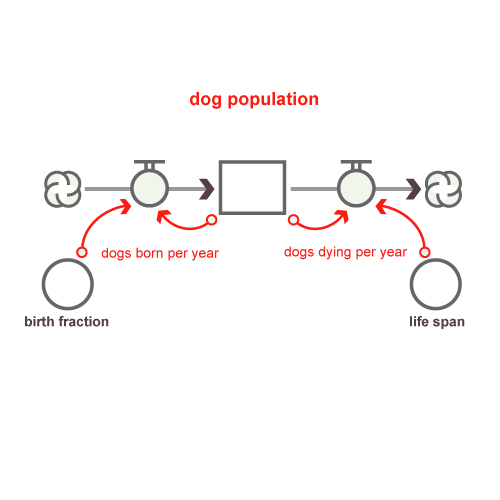
Stocks and Flows - System Dynamics basics
A number of people have contacted me about the Global Exchange report on Chevron's Oil Operations around the World called The True Cost of Chevron. There are two sides here: Chevron haters who want to make sure I see the report and then will salivate over what I blog, and Chevron itself who wants my view on the report because it's balanced.

It is so because when I was in Grad School at UC Berkeley in City and Regional Planning, what consistently angered me was how some third world countries failed to provide for the needs of their poorest citizens. Now, Chevron-haters fail to note the problems in those same countries that I paid attention to at Berkeley (and beyond to a degree.)

What's captured my interest on this for a while now is the pavlovian negative reaction of San Francisco Bay Area activists who work for non-profits or some alternative media types who know them to Chevron. It makes me wonder what trial lawyers, and I know a ton of them, are behind their work. It's so much of a one-sided view that one is compelled to look, and in this blogger's role as disrupter to just about any sacred cow, this issue is too juicy for this space to ignore. Especially considering the lack of a rigorous, System Dynamics perspective, which I will explain below.

First, I have to admit I love the comprehensive approach of the report. Done well, it could be used as a business plan for Chevron's future. But the problem is The True Cost of Chevron leaves out facts to make a negative point about Chevron, thus losing its value as a guide to corporate improvement. Let's take the case of Richmond.

Very recently, just last week, the City of Richmond and Chevron settled a long battle over tax payments and Gayle The Mayor of Richmond really came out looking good on that score. Here's what was decided:

- Chevron will pay an additional $114 million to The City of Richmond over the next 14 years.
- The City of Richmond will stop its ballot measure to change the Utility Tax and Chevron will remove its proposal.
- The City of Richmond will drop its appeal of the Measure T Ballot measure, which was ruled unconstitutional.
- Chevron would wave $1.2 million it sought from the City related to Measure T.
- Chevron will make community contributions totaling $8 million.

Again, I have been critical of Richmond Mayor Gayle McLaughlin on this in the past, but frankly I like her as a person so I was waiting, looking, and hoping for this kind of news. It's with us. So we think that battle's over, right? On to the Richmond Refinery issue? Right?

Well, if you look at the Global Exchange report, and you should do so, it doesn't at all mention the agreement. In an Internet age, one would think an update, one paragraph or two, would be easy to add. Not there.

That's the rub with the Global Exchange report. It is a list of anecdotal stories and tales to paint one view of a firm.

What I would have done if I were Global Exchange is this:

1) Build a comprehensive System Dynamics model of Chevron and its operations around the World.

My expertise is in the area of System Dynamics and I've built almost 200 models over my time. The best example is my Oakland Baseball Simworld sim which I built using the Forio Business Simulations FML Programming Language, and where one can run the business of the Oakland Athletics over a 15 year period and make decisions that are realistic. The sims has over 2,000 variables grouped in 956 equation sets. You can run thousands of scenario permutations, and the sim is based on real legal systems, like Redevelopment, and fiscal methods like franchise valuation.

Another System Dynamics (or "SD") model I constructed was in 1994 and for The East Bay Express and of The University of California at Berkeley's impact on The City of Berkeley.  The East Bay Express' editor John Raeside contacted me about building an "SD" model because he was convinced the University's decision to drop salary payments by five percent was going to harm the City of Berkeley.

For that, I created a 900 variable SD model, ran it several times, and concluded that the real economic issue wasn't the salary decrease, because the vast majority of UC Berkeley employees lived outside of Berkeley.  The real problem was rising Cal-Berkeley tuition costs, which choked-off student spending in Berkeley (remember about 60 percent of students lived in Berkeley at the time) and harmed Berkeley's sales tax revenue.

(You'd think Raeside would have been happy? No.  He wanted his view in SD form; I said I go with what the model runs showed and no changes for emotionalism.  Period.  End of story.  We parted ways. The model was an honest representation of the socio-economic dynamics of Cal in Berkeley.  I even predicted student demographic growth changes!  Given what's happened with rising tuition today, that study is more relevant than ever. )

In Chevron's case, I want to know how the business is ran in terms of the process of A to Z: from planning and development to oil extraction and distribution and consumption. One of the reasons I became interested in System Dynamics was Royal Dutch Shell's work using "Scenario Planning," and that was how I came to know the Emeryville - based Global Business Network. Peter Schwartz, who is one of the founders of GBN, used Scenario PLanning when he worked with Royal Dutch Shell in the 70s. (On a side note, one of the original members of GBN was Bob Klein, the owner of the now-famous Olivetto's Restaurant in Oakland.)

I'm not a fan of Scenario Planning without System Dynamics, because the outcome of any story is some kind of numerical picture. I tried to explain that to Schwartz a while back, but it didn't take with him. Not to be mean, just honest. It's important to understand the dynamics of a system and to do that, one must build a System Dynamics model. It's in the rigor of thinking about a system and then trying to build a representation of it that we understand it.

My Chevron System Dynamics Model would also include representations of government structure and country industry and demographics as they impact oil operations. Finally we would have to add concerns such as weather and earthquakes, and plant and investment rates over time, and local political, socio-economic, and criminal issues (like terrorism).

The end result would be a System Dynamics model that then allows one to test different corporate approaches. From that we can see their impact on firm's revenues and expenses and value. The uneducated will immediately jump to the idea that "it's all about money" but really having built so many of these models, I can explain that political issues always impact the bottom line.

From that I would write my report.

2 - Write An "Alternative Business Plan" For Chevron

The Chevron business plan would come from the conclusions after running the model. What's exciting about this approach is it allows us to actually see how the issues raised in the Global Exchange report impact Chevron and how different approaches and also improvements in the political problems of some of the countries where Chevron does business, impact the firm.

What's most valuable is the Chevron business plan can capture the attention of Chevron execs, shareholders, and activists. Online versions of the model would be open for anyone to run. It would change the nature of the debate about Chevron from its current, combative, at times idiotic, and really very anti-intellectual approach, to one that's reasoned, intelligent, and well-considered.

Global Exchange could very well be the organization that takes the steps I'm advocating. It would result in the most path-breaking effort since the Club of Rome's program that led to the World Models developed by Dennis Meadows and his team at MIT in 1971, and based on the paradigm of System Dynamics, created by Jay Forrester at MIT.  (And which was updated in the book Beyond The Limits which was based on a new model called World 3.)

Stay tuned because this cries for more on System Dynamics and Scenario Planning.

Tuesday, February 09, 2010

Chevron: Ecuador economist will be paid by Ecuador from judgement

The latest twist in the ongoing Chevron Ecuador case finds Chevron claiming that Ecuador's court-appointed economist Richard Cabrera will be paid by Ecuador from a judgement against Chevron, should the American oil company lose its case. According to CBS Marketwatch:


Recently uncovered records, from 2003 through 2008, show from 2003 through 2008, show Cabrera is co-founder, general manager, majority stockholder, and legal representative of an oilfield remediation company, Compania Ambiental Minera-Petrolera S.A. ("CAMPET"), which is registered to perform oilfield remediation and other services for Petroecuador.


In a press release, Chevron Vice President and General Counsel Hewitt Pate said, "For three years, Mr. Cabrera has concealed clear financial conflicts of interest that disqualify him from acting as an independent and objective evaluator of the evidence in the case. While Mr. Cabrera's financial interests alone are sufficient grounds for his report to be rejected, his intentional concealment of those interests further demonstrates that the entirety of his work lacks honesty, integrity, or credibility."

Ecuador is suing Chevron for $27 billion and for claims that between 1968 and 1992 Chevron / Texaco failed to clean up the Amazon Delta during and after its period of oil production, which stopped in 1992. Chevron asserts that it did clean up the area it was within and that since 1992, the state-run Petroecuador Company, which took over production from Chevron, has been responsible for the oil damage.

But the real, untold story is a messy and complex one, and has U.S. nonprofit organizations working as the "rabble rousers" for trail lawyers who claim to be concerned about the people of the Amazon, but have not sued the Government of Ecuador on that basis. An Ecuadorian judge, Judge Juan Nunez (who has since stepped down) and the government itself angling to make money from the Chevron lawsuit. And charges that the line of graft extends all the way to President Rafael Correa himself.

The real story is of a country that is just trying to nationalize its oil production. Ecuador has no real interest in cleaning up the Amazon, otherwise it would have changed the zoning to prohibit oil production long ago. The Ecuadorian Amazon has seen over 118 oil spills since Chevron left the region, yet Ecuador focuses on not just Chevron, but American Oil because it believes they have the resources and the cash such that they can be sued. The objective is simply to trap petrodollars for Ecuador's rich.

One of those who was allegedly working to gain a part of a $27 billion award was the man who came up with the number, Richard Cabrera. Chevron has been after Cabrera for over two years and with good reason. They simply feel he's not competent and attacked the methodology behind his initial findings of a $16 billion damage award, then went ape when he upped it to $27 billion without solid justification, accusing him of "Voodoo Economics."

The one fact that has long made Cabrera's estimates something from a cartoon is that Chevron has not operated in the region for 18 years, and the soil that Cabrera has looked at is not part of embargoed property; it's still used for oil production by Petroecuador and by Brazil, to name some of the organizations that have been active.

That economist Richard Cabrera has financial ties to Petroecuador explains how he could write an economic report that skips over almost 20 years of oil operations by Petroecuador, non-American oil firms and Brazil, and somehow point the finger at Chevron. Again, Ecuador believes America's companies are rich.

Ecuador has spent the better part of the Correa regime trying to scheme or outright take the means of oil production away from American companies. The greatest example of this being the ouster of Occidental Petroleum, and Ecuadorian workers getting into fist-fights over the left over luxury cars.

What would Richard Cabrera's ouster from the Chevron case mean? That the $27 billion damage claim was invalid. This news brought out Ecuador's lawyer Pablo Fajardo, who, according to the "It's getting hot in here" blog, said the following:


Cabrera disclosed to the court that he owned a clean-up company beforehis appointment as Special Master. This fact was properly cited by the court as one of the reasons he was qualified to do the damages assessment.

Chevron thought so highly of Cabrera’s qualifications that it accepted him as a court-appointed expert in an earlier part of the case and paid his fees as required by court rules.

The fact Cabrera’s company is qualified to bid on clean-up contracts offered by Ecuador’s state-owned oil company is irrelevant. That company, Petroecuador, is not a party to the case against Chevron and would have no role in any eventual cleanup.

Cabrera by virtue of his role in the case would be barred from having a role in a future clean-up.


Here, Pablo Fajardo is not telling the right tale and he's got paid bloggers helping him advance a mistruth. Ecuador is party to the case by its attorney general's own admission, and since Petroecuador is owned by Ecuador and is an oil company that too makes it a party to the case. That was settled long ago and by this blogger in this space. The best move for Cabrera is to step out of the matter.

If the organizations and bloggers attacking American oil companies really care about the poor of Ecuador, why don't they sue Ecuador? Hello? Answer?

Still don't have one.

Stay tuned.

Monday, April 05, 2010

Did lawyers suing Chevron in Ecuador case file fraudulent reports?

What does Ecuador President Rafael Correa think?
Related searches: Amazon Defense Coalition, Chevron ecuador, American oil company news, steven donziger, Charles Calmbacher, environmental law news

In a blockbuster development that could effectively crash Ecuador's entire case against Chevron (or as the plaintiffs claim, the Ecuadorian indigenous groups even though President Rafael Correa is reported to pay close attention to the case) - the charge that Chevron failed to clean up alleged environmental damage made during oil production operations during Chevron / Texaco operation in Ecuador until 1992 - fraudulent reports were filed claiming dangerous contamination was found at Amazon oil well sites.

The person who's signature is on the report and said to be its author, Dr. Charles Calmbacher, gave sworn testimony made in a deposition released by Chevron today that he did not sign or write the report that was used as a major arguing case by The Amazon Defense Coalition against Chevron.

According to The Wall Street Journal, Charles Calmbacher's name was misspelled on the very same report that lawyers suing Chevron said was written by him, and Calmbacher said his report exonerated Chevron - that "I concluded that I did not see significant contamination that posed immediate threat to the environment or to humans or wildlife around it," in a statement provided to the WSJ by Chevron.

According to an email from Karen Hinton, a spokesperson for the Amazon Defense Coalition, which serves as the "fiscal agent" for the lawsuit and organizational home for the plaintiff's legal work in Ecuador...


"Dr. Calmbacher clearly agreed to have his signature placed on materials, including reports, that were to be submitted to the court, and he acknowledged he was actively reviewing the reports with out local, technical team. We are bewildered, frankly, at his testimony"


Hinton points to comments made by Dr. Calmbacher on August 27th, 2004, when the New York Times quoted him as saying "Their defense is a lot like the tobacco industry saying there is no evidence linking smoking and lung cancer." However, according to a news post on Chevron's website, the statement was made before Calmbacher started the work and finished the report.

The Chevron website press release explains...


After the lawsuit was filed against Chevron in 2003, the plaintiffs' lawyers nominated Dr. Calmbacher, and the court appointed him to conduct judicial inspections of oil well sites in the former Petroecuador-Texaco Petroleum Co. concession area to assess alleged environmental damage. Dr. Calmbacher led those inspections for the plaintiffs, supervising the taking of soil and water samples, from August to October 2004.

The fraudulent reports were filed in February and March 2005, and later used by Lago Agrio court appointee Richard Cabrera in his $27 billion damage assessment against Chevron. Cabrera never investigated Sacha 94 or Shushufindi 48, yet specified more than $101 million damages based on the fabricated findings. Dr. Calmbacher also inspected Sacha 6 and Sacha 21, yet the plaintiffs' lawyers failed to submit reports containing his conclusions regarding those well sites. Dr. Calmbacher testified that he did not find a risk to human health or the environment, or a need for further clean-up, at any of the Texaco Petroleum-remediated sites he inspected. He also said he never concluded that Texaco Petroleum's remediation in Ecuador in the 1990's was not successful.


So, the Amazon Defense Coalition's leaving out a key detail regarding who filed the report. The person all of this falls on is Steven Donziger, the lead lawyer on this case, who's made a name for himself and admitted that he would make billions from a win against Chevron as I explained in this video in 2008:


Hinton of the Amazon Defense Coalition was contacted for a response on the disconnect between the statement she pointed to from the New York Times in 2004 and the completion and filing of the Calmbacher report in 2005.

The main question is who falsified and filed that report?

Stay tuned.

Wednesday, July 15, 2009

Chevron Richmond issue: Dennis Roos is the real "little guy"


More at Zennie62.com | Follow me on Twitter! | Get my widget!


YouTube, Yahoo, MySpace, Metacafe, DailyMotion, Blip.tv, StupidVideos, Sclipo and Viddler


On July 1st, Contra Costa Superior Court Judge Barbara Zuniga issued a decision that altered Richmond, California's economic course for the future. She ordered the oil giant to rewrite its environmental impact report (EIR) because of environmentalists' contention that the EIR was flawed and that a newly refurbished Richmond refinery would not produce lower carbon emissions than the current facility.

Her decision was hailed as a victory for "the little guy" by my friend San Francisco Chronicle Columnist Chip Johnson. But his column made me ask "Who's really the little guy, here?" So in a search for the answer to my query, I did some digging and found a person who represents the real "little guy": Dennis Roos. But before we meet Roos, a brief recap is in order.

Two Sides To A View

A year ago the Richmond City Council narrowly approved a development agreement allowing Chevron to refurbish the existing refinery. The contention with the approval, according to community activists, is that Chevron's working to use a "dirtier" yet cheaper to produce grade of crude oil. Chevron's claim was that the new process would result in cleaner air.

The approval set off a lawsuit filed against Chevron under the grounds that the refinery EIR did not meet California Environmental Quality Act (CEQA) quidelines. The Judge agreed and handed down the ruling which called for construction of the new facility to stop until the problem with the EIR was solved.

I think what's forgotten by many is the current state of the refinery. It's old and dirty, right now, and needs to be upgraded which will not happen because of this tribal culture we live in. What the real problem is, frankly, is that every time there's a development project there's someone who crafts a reason to stop it mainly because they're jealous that someone has done something big. Think about it. My point is not to poo-poo environmental concerns, not at all, but to get at something I've noticed and now have to ask bluntly: why are all the activists poor and struggling and always working against an organization or person they view as wealthy? It's a common theme. Some of these activists don't want to work with organizations to improve anything; they'd rather just stop them cold. Period. But why can't they pay the rent, these guys?

Chevron's not the best neighbor in all of this either. As one who's worked in government, I can say the best companies work years to gain the community's trust and to make sure that the needs of the people are met when they don't need anything. From people I've talked to for background information, this was the Chevron of Richmond's past.

Chevron would contend they're working with the community now, and their Richmond plant website gives a good presentation of what they're doing and have done in that community. From the website one can gather the idea that Chevron has been a major and positive part of Richmond's culture, or has tried to be. Somehow this news isn't reaching the community activists, but perhaps they're not listening or reading it to begin with. Maybe Chevron should try Twitter?

What happened? Why is it, particularly in California, we have "sides" to an issue that consist of people who don't talk to each other? Moreover, it consists of people who just don't like to think at all; they'd rather toss insults or lawsuits than have an intelligent conversation that leads to a workable agreement. It's all so tribal this new culture - one side puts out its view, the other has a view and we in the middle have to figure it out - it's done nothing to improve our economy or quality of life, and it cost Dennis Roos his job. I'm frankly sick and tired of this dumbed-down culture we've allowed to form. Whatever caused it, it's time for a push-back.

The Activist Mayor of Richmond


Richmond Mayor Gayle McLaughlin says the victory is a win for Richmond. But which Richmond? The people who need the jobs don't think it's a win at all and neither does the city's finance director Jim Goins, who said the ruling will "have an impact." (Hey, I guess Richmond's doing fine in this recession, huh? Someone needs to tell Mayor McLaughlin her city's unemployment rate is 10 percent and that the number of Richmond jobs has decreased 65 percent since 2007. Richmond's in trouble.

This is what I'm vexed about: the desire to "get a win" seems to have overruled any idea of "getting to yes" where both parties can agree and improve a community. Shame on Mayor McLaughlin for acting less like a leader and more like an activist. Mayor McLaughlin should talk to one of her own people about this so-called "victory": Richmond's Dennis Roos.

Dennis Roos is the little guy

Roos is a union electrician (with the International Brotherhood of Electrical Workers local 302 in Martinez, California) who grew up in Richmond and started working for Chevron there when he was in his 20s as a researcher of sorts. Then Roos took a series of jobs, building a reputation as an electrician who specializes in new facilities and remodeling (or what he calls an "inside wireman"), like the one Chevron had planned to build before Judge Zuniga handed down a questionable call. I talked to Roos about what happened and how it's effected him.

Roos explained that he'd already been released by Chevron and didn't know what he was going to do for income considering his normal obligations and the fact that he has two daughters: one in college and the other just graduated from high school. At any rate Roos said he was laid off, he thought prematurely, and without other job prospects forced to go on unemployment. "It's pretty detrimental to the economy (of Richmond and myself) and I'm reduced to what I call necessity spending." Roos recently bought a new home and as a result of that and the court action against Chevron, he's not in the best financial shape at all. (He's looking for work, so please contact me if you have any opening and I will relay that information to him.)

A terrible decision 

Judge Barbara Zuniga could have resolved this issue in a way that helped all parties. Rather than order a stoppage of work to solve the environmental impact report problems, Judge Zuniga should have ordered the formation of a group of community activists and environmentalists to work with Chevron and then install the project change orders necessary to make sure the refinery's production process was "cleaner" in its emissions release than before. This would have saved the 1,000 jobs that have been removed - and perhaps even the 3,000 total refinery jobs that are now in question as Chevron considers moving production south to El Segundo - and made sure Richmond got the $61 million in community benefits from Chevron it negotiated for, which by the way lead to more jobs. Instead, Judge Zuniga made a terrible worst case call that harmed Richmond, Chevron, and workers like Dennis Roos.

Thursday, November 06, 2008

Bowoto v. Chevron - Chevron Did Not Violate Human Rights According To Article

This article below gives a balanced view of what happened in Nigeria between Larry Bowoto and Chevron and why the case is important.


LOS ANGELES, Oct. 27 -- Chevron Corp. is at the center of a legal case before federal court in San Francisco that will ask jurors to decide whether the firm sanctioned human rights abuses that resulted in the deaths and injuries of protesters at its Nigerian facilities, or whether the company was simply protecting its employees from belligerent kidnappers.

The lawsuit—identified as Bowoto vs. Chevron, No. C99-2506SI (N.D. Calif.)—alleges that Chevron, in conjunction with the Nigerian military, engaged in torture, assaults, and the killing of two protesters over Chevron's environmental record and its failure to hire locals in the delta region near its oil drilling operations.

Both sides in the current case recognize that the impending courtroom battle, described by one observer as "epic," has legal implications that reach far beyond a single incident by one corporation operating in Nigeria.

"This case could have serious ramifications for workers in developing parts of the world," said Charles A. James, Chevron vice-president and general counsel.

"If plaintiffs had their way, a company could not report hostage-taking to law enforcement authorities without facing the threat of a lawsuit in the US," James said.

Dan Stormer of Hadsell, Stormer, Keeny, Richardson & Renick in Pasadena, Calif., is representing the plaintiffs, a group of Nigerians who were injured during protests on a Chevron offshore oil platform in 1998.

Stormer said his firm is trying to hold a corporation liable for their bad actions in another country, even if it is committed by their surrogates, a wholly owned subsidiary, or by the Nigerian government.

According to Chevron, the hostage-taking incident occurred 10 years ago on oil facilities operated off the Nigerian coast by Chevron Corp. subsidiary Chevron Nigeria Ltd. (CNL). More than 100 CNL workers and contractors were held for ransom and threatened with acts of violence.

Chevron said the incident began when plaintiff Larry Bowoto and other members of the Concerned Ilaje Citizens, an unsanctioned Nigerian community group, threatened CNL with violence and sea piracy if the company did not pay them money and give them jobs.

Weeks later, according to Chevron, they followed through on their threats by seizing the oil platform, an adjacent barge, and a tug boat on May 25, 1998, holding CNL employees and contractors hostage and demanding money and other considerations. CNL attempted to negotiate a resolution without success...MORE

Monday, July 07, 2008

Chevron Pipelines Attacked In Nigeria and Columbia; FARC May Be Responsible In Columbia

In the ongoing matter of Chevron and Nigeria comes a report from UPI declaring that "Nigeria attack cripples Chevron". Moreover, the same report points a finger at militant groups like the Movement for the Emancipation of the Niger Delta (MEND). And while there's no recorded link between MEND and Chevron accuser Larry Bowoto, it seems the two have similar aims: to cripple Chevron's presence in the region, as well as that of Royal Dutch Shell.

Consider this UPI report:

Chevron Corp. has declared a force majeure on its oil exports following a particularly destructive attack on one of its installations in the Niger Delta.
Officials at the U.S. oil company said that though production was unaffected at offshore installations, Chevron could not meet its production quotas for customers because of shortfalls caused by the pipeline attack last week at the Escravos oil field in the delta.

Though Chevron would not say just how much production was lost due to the attack, Nigerian energy officials estimated the losses at over 100,000 barrels per day, a blow that prompted the company to declare force majeure, relieving them of their contractual obligations until the assaulted pipeline can be repaired and secured.

Chevron, meanwhile, is not the only company reeling from the recent increase in violence against foreign oil interests by armed militant groups in the delta. Royal Dutch Shell (NYSE:RDS-A), the leading foreign petroleum company operating in Nigeria, suffered yet another in a long list of attacks at its Bonga facility last week, prompting the Anglo-Dutch company to halt production for several days.

It wasn't the first time Shell was forced to scale back production due to militant violence. In January, Shell shut down operations at its Forcados terminal following pipeline attacks that threw its 100,000 barrel-per-day production offline. The terminal already had been shut once before because of violence and reopened in October 2007 after more than a year of halted production. Since its reopening, the facility, which can produce some 450,000 barrels per day, had been operating at a fraction of its capacity.


FARC May Be Behind Anti-Chevron Ecuador Efforts

It seem that MEND has something in common with FARC, the same organization that kidnapped now freed politician Ingrid Betancourt: both have apparently bombed Chevron pipelines. in FARK's case, such an activity has been ongoing since 2001, but not limited to Chevron at that time; Petroecuador pipelines -- Petroecuador has long been a partner to Chevron in the region -- were the targets of that Columbian rebel group and that continues today.

Since Ecuador's charging that Columbia's using U.S. made weapons, it seems that Chevron's made as the scapegoat, when it provides much needed employment to the region as is true in Nigeria.

Wednesday, October 08, 2008

Chevron v. Ecuador - Can Chevron Get A Fair Trial? Appellate Court Screws Up

As some of you know, we've been following the Chevron - Ecuador story for some time now.  To recap, the problem is that in the 1960s Texaco produced oil out of that country and through 1990 and in partnership with the Country of Ecuador .  During that time, there were oil spills and economic damage due to oil production.  Texaco spent $40 million in "environmental remediation" which is another term for carrying out a cleanup program.  


Chevron purchased Texaco in 2001 for 46.3 billion, thus assuming Texaco's work and responsibilities in Ecuador.  By that time, Ecuador's then-new state-owned petroleum organization Petroecuador assumed responsibility for the oil wells that were once the product of the partnership.  But the problem is that since that time and through today, oil spills and environmental damage have continued, but Petroecuador has done nothing to either prevent the occurrence of or clean up what was done.  


Meanwhile, the Country of Ecuador has moved to work on three fronts: 


1) Nationalize the oil industry via Petroecuador
2) Kick out American oil companies like Occidental Petroleum and take over their production facilities.
3. Sued Chevron Texaco to get money to pay for environmental damage that their own state-owned oil company, Petroecuador, caused


The third point is the focus of my blog.  Ecuador's suing Chevron to have them pay the afforementioned damange.  To that end, they were assisted by a lawyer by the name of Steve Donziger, who had been working on the case as an "American Legal Advisor",  but who has also admitted his own financial ambitions as he could gain $5 billion from a victory .  The lawsuit -- valued at $16.5 billion by one estimate -- has been the focus of much legal movement.  The latest action by Chevron had it file an appeal to have Ecuador enter into arbitration discussions regarding the level of liability each party is responsible for.  But there's one large problem. 


The appellate court doesn't understand the contractual relationships. It calls Chevron a "third party."  


What!?!


When Chevron purchased Texaco it essentially became Texaco, with all of its obligations and problems. Thus, it's not a third party.  But even with this fact, the U.S. Court of Appeals for the Second Circuit in New York took the step of ignoring Chevron's claims of being able to pursue arbitration by seeing it as a "third party" when it's not.


The result of this failure means that Chevron now must seek other legal tools to get Ecuador to pay its fair share, but the other problem is more sinister: Ecuador's rich continue to cover-up their behavior and irresponsibility toward that country's poorest people.  Making it look like it was just Chevron's fault does not erase the fact that Ecuador has been harming its poorest people.


The bottom line here is that just because a firm's an oil company does not mean it should be treated unfairly, especially when the lives of the poor of Ecuador are at stake.  Chevron / Texaco has paid and does its share; the Country of Ecuador, which by the way will never give Chevron a fair trial, has not done so. 

Monday, August 10, 2009

Richmond, Ca Mayor on Chevron refinery issue

More at Zennie62.com | Follow me on Twitter! | Get my widget! | Visit YouTube | Visit UShow.com


On YouTube.com

In the wake of my interview with Chevron employee Dennis Roos I've gotten a number of email and calls updating me on the matter of the negotiations to restart the stopped construction of the improvements to the Richmond refinery.

One of them was this "Meet The Mayor" community meeting held Friday, August 7th at 5:30 PM. Here, one could ask questions of Richmond Mayor Gayle McLaughlin for one hour, but my intent was to attend, film residents who were concerned about the project, pro and con, and after it was over, get the Mayor's direct point of view if she would give it to me. (Take note of that.)

To review, Chevron's planned upgrade of their giant Richmond oil refinery was stalled because environmentalists sued them in court regarding what was viewed to be an inadequate environmental impact report (EIR) regarding how emissions were going to be lessened over current levels. Contra Costa County Superior Court Judge Barbara Zuniga agreed with their view and ordered planed construction stopped until Chevron could create a "better" EIR. The judge's decision threw over 1,000 construction employees out of work and threatened the future of Chevron in Richmond.

So I did arrive and sat next to a white-haired gentleman who as it happened gave me a copy of a letter I'd not seen from Richmond's Mechanics Bank. The letter stressed the importance of keeping Chevron in Richmond and arriving at a settlement to get the plant project going again.

So the meeting started and as the Mayor listened to people introduce themselves I explained that I was a video-blogger who wanted to ask her about the plant matter after the meeting was over if I could. She did say that was fine.

There were only two people who came to the meeting to talk about the refinery issue. The first person, an African American man, said that the Mayor seemed not to care about the people who need jobs and more about her own agenda (this is in the video). The Mayor said that she does did support a support a substitute to the the resolution voted on by the Richmond City Council two weeks ago calling for settlement talks (with California Attorney General Jerry Brown involved) so that all the workers can get back to their jobs and she's working to make that happen. The Mayor said doing this is important because Richmond has a 17 percent unemployment rate.

A few minutes later, and after a number of residents expressed concern for and presented programs to stop the violence plaguing young African Americans in Richmond (which was heart-breaking to see, no matter how many times I am presented with this issue), the man I was sitting next to, who's name was Richard Lompa, asked the Mayor about the bank letter, and explained that he didn't understand "why do we continuously bash Chevron" and quoted the letter written by Mechanics Bank President and CEO Stephen Foster which said the reason given for opposing Chevron doesn't stand up to scrutiny . He said no one would support Chevron putting out more pollution, and that it was as if she was plunging a dagger in the heart of the city.

The Mayor's response was that the judge made the decision and then she threw in that Chevron does not pay its fair share of taxes and talked about the company's court battle against Measure T which imposed a new tax structure for manufacturers like Chevron. She also pointed to Chevron's appeal of its property tax assessment.

After the meeting and people left the room, the Mayor did give me her time and put to rest the idea some have expressed that she was not talking to Chevron, stating that she talks to representatives of the firm every day.

Mayor McLaughlin then essentially repeated her claim that Chevron doesn't pay its taxes in response to my question that as a person trained and who's practiced economic development, tax reductions are a normal part of negotiations to make it easier for employers to maintain their business in a city. She asked if I was referring to the Measure T issue, and repeated what she said before regarding the firm not paying its fair share of taxes. Then, weirdly and after presenting herself well on camera but before I could deactivate it, suddenly turned and said "I have a community meeting" but I turned the camera to show that the meeting had ended long ago. Moreover, the Mayor agreed to give me just a moment of her time, and I gave her a platform to present herself; the Mayor didn't say she had more people to meet when we started the interview. She didn't have to essentially rain on her own parade but that's what happened as one can see and I'm really disappointed that she did that. I turned off the camcorder.

As I went outside, Mr. Lompa was talking to another person, but after he finished gave me his view. "The Mayor," he said, "was being shallow and not grounded with reality" regarding her repeating of the idea that Chevron has a $24 billion profit. He also said that he appeals his tax bill if he thinks it's not valid.

I agree with Mr. Lompa, but I'm really concerned that the good Mayor seems to have more of a personal agenda that may cloud her ability to effectively negotiate with Chevron. It's common practice for businesses to want and ask for tax reductions and its equally normal for city economic development officials (and that includes the Mayor) to structure rates that help businesses.

In all of my years in the public sector I've not seen or met a Mayor that didn't understand that, but Mayor McLaughlin's a new breed of activist city official. That's all well and good for getting elected but it seems to cloud one's ability to conduct the business of maintaining a municipality's economy. One can have their personal beliefs but when a city's unemployment rate is at almost 20 percent as is the case in Richmond, its a recession, and the job base has decreased by over 50 percent in the last two years, it's time to be more pragmatic and less antagonistic.

Thursday, October 21, 2010

Chevron Ecuador Case: Judge Allows Chevron To Depose Steven Donziger

A big break for Chevron in the Chevron Ecuador Case. U.S District Court Judge Lewis A. Kaplan has written an order allowing Chevron's lawyers to depose Steven Donziger.  (Or in plain terms, be grilled by Chevron's lawyers.)

Steve is the key figure in the long legal battle between the American Oil Company and what Donziger has claimed were Ecuador's indigenous people, but what has been reveled to be Ecuador itself, including Ecuador's President Rafael Correa.

As revealed in this blogger's last post on the Chevron Ecuador case, outtakes from the movie Crude, which was released this year and about the plaintiff's claims that Chevron caused environmental damage to the Ecuador part of the Amazon Delta (whereas Chevron maintains that they did substantial remediation work and have not produced oil there since 1992, turning over operations to the state's oil company), revealed a person who planned a way to intimidate and bully the Ecuador court.

Donziger openly talked of using paid "armies" of Ecuadorians to harass the Ecuador judge, and is on record as having conversations with President Correa and executives from the state oil company called Petroecuador.  Thus, contrary to the assertions of AmazonWatch, Ecuador has been a party in the lawsuit from day one.  

Here's what Donziger said at one point:


"We have concluded that we need to do more, politically, to control the court, to pressure the court. We believe they make decisions based on who they fear the most, not based on what the laws should dictate. So, what we want to do is to take over the court with a massive protest that we haven't done since the first day of the trial, back in October of 2003. Remember all those people on the street? ... It's a huge effort, it costs money. Not that much actually, but, few thousand dollars, to get everyone in for a day. ... But it — it's — it's a critically important moment, because we want to send a message to the court that, 'don't fuck with us anymore — not now, and not — not later, and never."


Legal observers have called Donziger's actions "criminal."

Judge Says Importance Of Discovery Is "High"

This is what Judge Kaplan wrote in the order, which was provided by blogger Bob McCarty and you can see here (link):

In view of the facts that (1) the Individual Petitioners are facing a preliminary hearing in the criminal proceeding in Ecuador on November 10, 2010 and (2) the Lago Agrio plaintiffs are seeking to move the Ecuadorian civil litigation to judgment as quickly as possible,4 petitioners have an urgent need for any discovery to which they are entitled here. The Court therefore now rules in this summary form on the motions to quash with the understanding that more extensive findings and conclusions will follow as promptly as the Court’s other responsibilities permit.

The Court has had the benefit of extensive evidentiary submissions, legal briefs, and oral argument. It has had an opportunity to review the Crude outtakes, which are extraordinarily
Donziger and the Lago Agrio plaintiffs rejected this Court’s suggestion that proceedings in Ecuador be stayed pending a more extended determination of these motions.

On the basis of those materials as well as the extensive evidentiary submissions, briefs,
and argument, the Court makes the following findings and conclusions. First. The Section 1782 statutory requirements are satisfied, and the discretionary factors weigh in favor of discovery.

The reasons they do so are at least as strong as those which led to the same conclusion in Chevron I, where this Court granted the applications for Section 1782 subpoenas for the Crude outtakes. Moreover, the Individual Petitioners seek documents and testimony from Donziger that are highly relevant to their pending Ecuadorian criminal proceeding while the relevance of the evidence sought by Chevron is even clearer than was the case with the outtakes.

The government of Ecuador is prosecuting the Individual Petitioners for alleged fraud in connection the Settlement and Final Release agreements among Texaco, the Government of Ecuador, and Petroecuador, Ecuador’s state-owned oil company. These same charges were dropped several years ago after Ecuadorian prosecutors concluded that there was no basis for criminal liability.5

The outtakes, however, depict Donziger, along with others acting for the Lago Agrio plaintiffs, describing their campaign for a renewed criminal investigation of the same allegations6 for the purposes of (1) undermining and defeating the agreements to bolster their claim that Chevron is liable notwithstanding the prior settlement and (2) exerting pressure on Chevron by prosecuting
its personnel.

The Prosecutor General changed course and reopened the criminal investigation in light of new evidence7 within days of the completion of the ostensibly neutral and impartial “global assessment” for the civil litigation. This “global assessment” is the central focus of the discovery that the Individual Petitioners and Chevron seek. The Lago Agrio court appointed an ostensibly independent expert to submit a neutral report.8

The outtakes, however, contain substantial evidence that Donziger and others (1) were involved in ex parte contacts with the court to obtain appointment of the expert,9 (2) met secretly with the supposedly neutral and impartial expert prior to his appointment10 and outlined a detailed work plan for the plaintiffs’ own consultants,11 and (3) wrote some or all of the expert’s final report that was submitted to the Lago Agrio court and the Prosecutor General’s Office,12
supposedly as the neutral and independent product of the expert.

In these circumstances, the outtakes and other evidence demonstrate at least a significant need for the discovery sought by the Individual Petitioners and Chevron – discovery concerning, inter alia, the role of the Lago Agrio plaintiffs in selecting and procuring the appointment of the expert, in writing his report, and in procuring the reopening of criminal charges against the Individual Petitioners. The likely relevance of the discovery sought is high.

Stay tuned.

Friday, September 04, 2009

Chevron Ecuador: Amazon Defense Coalition's statement on Judges' recusal

More at Zennie62.com | Follow me on Twitter! | Get my widget! | Visit YouTube | Visit UShow.com

The Amazon Defense Coalition sent this email to me containing their statement responding to the news that Ecuadorian Judge Juan Nunez recused himself in the wake of a video that captured him in a meeting explaining how he planned to rule in the Ecuador / ADC lawsuit against Chevron.

The statement:

Judge’s Recusal Clears Path For Legal Proceedings to Continue
Validates Chevron’s Initial Faith in Ecuadorian Court System

Quito, Ecuador (September 4, 2009) – Steven Donziger, attorney for the plaintiffs, said:

The judge’s decision to recuse himself clears the path for the legal proceedings to continue uninterrupted. This appears to have been done by the judge to disrupt Chevron's intention to further delay a litigation that has lasted 16 years. The judge’s action once again validates the effective functioning of the Ecuadorian legal system — a system that Chevron chose as the best forum to hear the lawsuit. The vast majority of the competent evidence in the case, including all the evidence used as a basis for the $27.3 billion damages assessment against Chevron, was received by the court prior to the tenure of Judge Nunez.

We again call on competent authorities in Ecuador and the United States to investigate any role Chevron and its officials might have played to script a bribery scheme for purposes of extracting an advantage in a private litigation.


The recusal does not change the overwhelming evidence against Chevron in the underlying case. The evidence in that case demonstrates clearly Chevron’s responsibility for wrecking the rainforest, decimating indigenous groups, and putting thousands of Ecuadorian citizens at grave risk.”


NOTE: Chevron’s main defense is that a 1995 remediation agreement, signed with the government of Ecuador two years after the lawsuit was filed in the US in 1993, releases the company from all responsibility for the contamination. However, it is important to include that the agreement specifically carves out individual, third-party claims, such as ours, in the agreement. Chevron was not released from lawsuits such as the Aguinda vs Chevron case. Also, evidence in the Ecuadorian trial has found that the oil wells and pits that Texaco claimed to have cleaned in the remediation agreement test today at extremely high and illegal levels of toxic contamination. The plaintiffs maintain that the remediation agreement was a sham. Two Chevron lawyers, who worked for Texaco at the time, and seven former Ecuadorian officials have been indicted for fraud.

Monday, October 13, 2008

Chevron v. Ecuador - Chevron Files Response To "Fraudulent" Court Report

I'm just updating you on news related to the ongoing legal battle between Chevron and Ecuador:

California-based oil major Chevron (NYSE: CVX) has filed a written response to a court-ordered report in a trial related to alleged environmental damage in Ecuador.

The superior court in Nueva Loja, Ecuador, asked Richard Cabrera to write the report after the plaintiffs aborted a judicial inspection process of the alleged pollution in Ecuador, Chevron said in a statement.

"The findings of the Cabrera report are clearly fraudulent and intended to cause damage to this US company and its shareholders," Chevron general counsel Charles James told reporters in a conference call.

"This report would not withstand scrutiny - be it technical, scientific or legal - in any responsible independent court anywhere in the world," he said.

Chevron believes Cabrera, helped by the plaintiffs, "manipulated" findings to justify false conclusions. Cabrera failed to present evidence for a number of claims and did not look at drinking water samples to prove contamination, according to the Chevron statement.

"It is hard to read Mr Cabrera's report and find a single table, page, assertion or data point that we wouldn't take issue with," James said when asked whether there was any truth to the Cabrera report. "He did put his name on the report and I presume that's correct."

The Cabrera report estimates damages of US$7bn-16bn - a "reasonable" amount that actually "underestimated the number of deaths from cancer due to the oil contamination," the Amazon Defense Coalition, a NGO that supports the plaintiffs, said in a statement.

In fact, plaintiffs have submitted papers to the court asking Cabrera to calculate how much it would cost to remediate groundwater and surface water not included in the assessment.

"There is significant evidence of groundwater and surface water contamination in the record yet no damages to remediate the impacts," Pablo Fajardo, the Ecuadorian lawyer for "dozens" of Amazon communities and five indigenous groups suing Chevron, said in the NGO's statement.

The trial stems back decades, when Ecuador's state oil company Petroecuador led an E&P project with partner Texaco Petroleum (Texpet), which years later merged into Chevron. The Petroecuador-Texpet partnership resulted in total crude production of 1.7Mb, with Texpet - which stopped operating in the country in 1992 - taking 5% of the financial proceeds, according to Chevron figures.

Ecuador's government in 1999 enacted a new environmental statute that allows any Ecuadorian resident to file a collective suit for environmental reparations. As a result, plaintiffs filed suit against Chevron in 2003, alleging environmental damage under the Texpet project.

Although Texpet had a minority stake in the project, plaintiffs allege it did substandard work and made major decisions about project technology and methodology.

Chevron denies the allegations and says it performed a US$40mn remediation project that gave it final immunity from claims resulting from its participation in the consortium.

Saturday, March 07, 2009

Chevron Wins in Judge's Decision To Deny New Bowoto v. Chevron Trial

 This was a major victory for Chevron, which was falsely accused of violating the civil rights of Larry Bowoto and bis friends in the Niger Delta region.  Here are my thoughts:

 Here's the news story as seen in the SF Chronicle:  
A federal judge on Wednesday upheld a San Francisco jury's verdict that cleared Chevron Corp. of wrongdoing in the shootings of Nigerian villagers who occupied an offshore oil barge in 1998 to protest the company's hiring and environmental practices.
U.S. District Judge Susan Illston, who presided over the four-week trial in November, denied a request by the villagers' lawyers for a new trial and ruled that there was evidence to support the verdict.
About 150 tribesmen from the oil-rich Niger Delta occupied a barge tethered to Chevron's Parabe platform in May 1998, saying the company's Nigerian subsidiary had refused to meet with them and hear their complaints that drilling and dredging were polluting their wells and killing trees and fish.
The villagers said they were unarmed and peaceful, but Chevron's witnesses said the protesters threatened violence, held crew members hostage and demanded ransom. After three days of negotiations, Chevron summoned Nigerian security forces, who killed two men and wounded two others.
The suit was filed under a law passed by the first Congress in 1798 that allows foreigners to seek damages in U.S. courts for violations of international human rights.
On Dec. 1, a nine-member jury unanimously rejected the plaintiffs' claims that Chevron was responsible for assault, inhumane treatment, torture and wrongful death.
Chevron has asked Illston to order the villagers to reimburse the company for $485,000 the company spent defending against the suit. The judge did not address that request in Wednesday's ruling.
In seeking a new trial, plaintiffs' lawyers said Chevron never contradicted testimony that three villagers were shot, beaten or tortured without justification. But Illston said jurors could have had doubts because of contradictions in the testimony.
She also said the jury could have found that the company was not responsible for the actions of military forces, citing Chevron testimony that its Nigerian subsidiary did not control the security forces and that its main concern was the safety of its workers.
Chevron, based in San Ramon, said it was pleased with the ruling. Plaintiffs lawyer Theresa Traber said the villagers would appeal.

Thursday, March 11, 2010

Chevron Ecuador issue: Chevron wins court victory against Ecuador

In the ongoing court battle between Chevron and the Country of Ecuador, Chevron won a court victory against Ecuador today. According to Reuters, A U.S. District Court Judge in U.S. District Court for the Southern District of New York, granted Chevron the right to pursue an order to have via Ecuador to complete environmental cleanup work it and the state-run Petroecuador Oil Company were to have done when it took over oil production from Chevron-Texaco in 1992. Chevron will seek to have this done under the "U.S. - Ecuador Bilateral Investment Treaty."

In a statement sent to this blogger, Chevron said...

Chevron is pleased that the Bilateral Investment Treaty arbitration can proceed. Chevron is seeking to hold Ecuador and its government owned oil company, PetroEcuador, to the promise they made to complete the environmental cleanup of the Amazon. Texaco Petroleum did its share of the cleanup as promised, and PetroEcuador now needs to own up to its promises and address the environmental problems wrongly being blamed on Chevron. Only the international arbitration panel can bring Ecuador to the table and compel PetroEcuador to do the right thing and clean up its oil fields. With today's decision, we are one step closer to making that a reality

The court ruling has huge implications for Ecuador's oil production strategy. First, Ecuador has pursued a course of oil nationalization since 1990, but during that time has failed to make timely improvements in oil production facilities or adequately clean up oil spills. There have been over 100 oil spills in the Amazon Delta region since 1992.

Ecuador has embarked on a systemic removal of American oil companies. The most recent major example being Occidental Petroleum in 2007, where Ecuador literally kicked out Occidental from its property siting a breach of contract. Ecuadorians then had fist fights over the left over luxury cars.

When Ecuadorian President Rafael Correa came to power in January of 2007, he had pressures from two sides. First, Ecuador's environmental activists wanted more attention to cleanup of the Amazon, but state officials wanted to continue the nationalization of petroleum production. Correa crafted the perfect head-fake strategy: ask for money from oil companies to clean up the impacted areas of Ecuador, but continue and expand state oil production. Causing Chevron to pay billions for a cleanup project it was only partially responsible for was part of the strategy. The U.S. Court's decision has wrecked that approach.

Much of the opposition to Correa from activists has been muted by Ecuador's horrible treatment of the press. Teleamazonas, a TV station that reported that a natural gas exploitation on Puna Island could cause the suspension of fishing for up to six months, was shut down in December of 2009 for three days, according to The Committee to Protect Journalists. In 2008, a local journalist working to point to corruption in the judicial system was jailed for 10-months.

Ecuador has worked to keep quiet its mishandling of oil production and the resultant environmental damage, while encouraging the media and using the courts to force American and foreign oil companies to pay for the oil-related mess Ecuador caused, and fooling American activists groups into helping Ecuador's government nationalize its oil production. Today's ruling will have a major impact in altering that course of behavior.

Stay tuned.

Wednesday, May 12, 2010

Chevron and Richmond kiss, make up, and think with new agreement

Last week this blogger wrote that Chevron and Richmond needed to "kiss, make up, and think. Well, it seems all the time both parties were doing just that.

Communications from the Richmond Progressive Alliance and from Chevron report the completion of an amicable agreement that stops the chance that Richmond will lose millions due to a June ballot measure that looked like it was going to pass, and Chevron stopped paying out $15 million more than it had annually given to the City of Richmond.

The Chevron press release neatly bullet-points the resolved issues:

• Chevron will pay an additional $114 million to The City of Richmond over the next 14 years.
• The City of Richmond will stop its ballot measure to change the Utility Tax and Chevron will remove its proposal.
• The City of Richmond will drop its appeal of the Measure T Ballot measure, which was ruled unconstitutional.
• Chevron would wave $1.2 million it sought from the City related to Measure T.
• Chevron will make community contributions totaling $8 million.

This ends the waring between groups and at times people in Richmond. Now, Richmond will have its largest employer remain and is able to focus on the huge problems of crime and education.

Richmond should use this opportunity to mend fences with Chevron over its renewal project. Clean air, more than a 1,000 jobs are at stake and the City should take the leadership position to support Chevron to get the project moving forward. It’s good for the environment, for working men and women of labor and for the City of Richmond.

A great job by both the Mayor of Richmond and Chevron Refinery Manager Mike Coyle. It also helps Mayor Gayle McLaughlin case as shes's up for reeelection this fall.

Stay tuned.

Thursday, December 02, 2010

Ecuador In Bed With Chevron Accuser Donziger: U.S. Judge Lewis Kaplan

Judge Lewis Kaplan
Revealing what this blogger has charged for a year, the government of the country of Ecuador was identified as a party to the fraudulent lawsuit brought against American oil giant Chevron by lawyer Steven Donziger and the so-called "indigenous people" of the Ecuadorian Amazon River Delta.

In a 32-page document, Lewis Kaplan, U.S. District Judge, Southern District of New York, wrote that the The Republic of Ecuador's motion to intervene to block the transfer of documents relevant in the deposition of Donziger by Chevron lawyers was denied.

In the pages of the Judge's decision, Judge Kaplan reveals that Donziger failed to even note that the so-called "indigenous people" who are the Lago Agrio plaintiffs were either the focus of any one of the 8,652 documents in question, or that any one - one - of those items was written by the Lago Agrio plaintiffs.

Not one.

The Republic of Ecuador then claimed that it has an interest in those same documents, revealing itself, clumsily, to be a party to the same lawsuit that Amazon Watch tried to bully SFGate.com into having this blogger claim Ecuador was not a party to, last year.

That's right.

In an email on September 17, 2009, Amazon Watch tried to get SFGate.com to make me say this:

"The government of Ecuador is not the architect of the Chevron lawsuit, is not a party to the lawsuit, and will not be the recipient of any judgment paid by Chevron. This is a civil suit by private citizens."

I stood my ground and said that I would write a reason why Ecuador was party to the lawsuit against Chevron. Here's what I wrote, thanks to Bob McCarty:


Amazon Watch is wrong! In my previous blog post, I issued the argument proving that the Government of Ecuador was so involved in the "Aguinda v. Chevron Texaco" lawsuit that even though the were not officially a listed party, they could be named a party in court if the challenge to their status was presented.


Now, investigative blogger Bob McCarty has revealed that Ecuador is indeed a party to the case. Remember that Amazon Watch asserted...


"The government of Ecuador is not the architect of the Chevron lawsuit, is not a party to the lawsuit, and will not be the recipient of any judgment paid by Chevron. This is a civil suit by private citizens."


Yeah. Right.


According to McCarty's blog post , Washington Pesantez, Ecuador's Prosecutor General, said 90 percent of the $27 billion award would go to Ecuador if the court case was resolved against Chevron for that amount.

That silenced Amazon Watch.  Now, the organization that rails about this blogger's credibility has egg on its face.  Judge Kaplan has officially outed Ecuador as being involved in the lawsuit.   Indeed, between Ecuador claiming it would take 90 percent of any environmental damage award from an Ecuadorian court, Donziger talking of using threats of violence and intimidation against Ecuadorian judges, and Donziger claiming that he, indeed, would make billions from the case, and Donziger working with the State of Ecuador's oil company that took over Chevron's oil well, it's clear that the last people anyone really thought of was Ecuador's poor.

Indeed, Chevron has been out of Ecuador for so long,  18 years, that the real story of oil spills and environmental damage by Petroecuador and other non-American oil companies has not been effectively told.

Stay tuned.